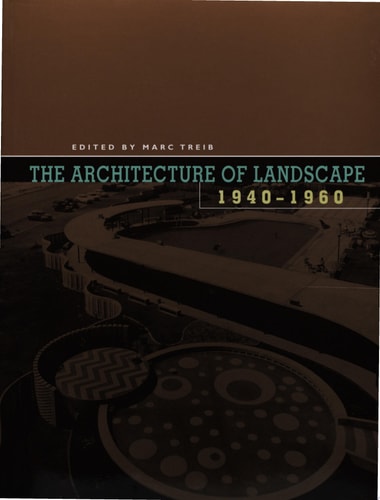
The Architecture of Landscape, 1940-1960
0
0
As an Amazon Associate and affiliate partner, Menrva Books earns from qualifying purchases. Learn more
Author Description
Following the end of World War II, the primary tasks for many countries were land clearance, reformation, and reconstruction, as well as the reestablishment of functioning infrastructures. These social and environmental concerns, with parallel developments in the fine arts, fostered many of the century's most consequential developments in landscape design and architecture, and set the course that we still follow to a large degree today. With over two hundred illustrations in ten essays by noted historians and theorists from around the world, The Architecture of Landscape, 1940-1960 offers a comprehensive analysis of landscape architecture during an epoch when geographic limits became less important than a sense of world development and an international community of values and design ideas. In this sense, it is a landmark publication. Contributors: Thorbjörn Andersson, Malene Hauxner, Alan Powers, Dorothée Imbert, Gert Gröning, Catherine Howett, Dianne Harris, Rossana Vaccarino, and Philip Goad.
Menrva's Summary
THE THESIS
The Architecture of Landscape, 1940-1960 examines the pivotal period following World War II when global reconstruction efforts and evolving artistic movements profoundly shaped landscape design and architecture. This era saw a shift from purely geographic considerations to a broader sense of global development and shared design ideals. The book analyzes how these social and environmental concerns, coupled with advancements in the fine arts, led to consequential developments that continue to influence contemporary practices. It presents a comprehensive overview of landscape architecture during a time of significant international collaboration and evolving values.
THE SCOPE MAP
- Analysis of landscape architecture and design from 1940-1960.
- Exploration of post-WWII land clearance, reformation, and reconstruction.
- Discussion of parallel developments in the fine arts and their influence on landscape design.
- Examination of how geographic limits became less important than global development.
- Insights into the establishment of an international community of values and design ideas.
- Contributions from ten noted historians and theorists.
- Over two hundred illustrations.
THE AUTHORITY PERSPECTIVE
This publication is recognized as a landmark in the study of landscape architecture, offering a comprehensive analysis of a critical period. The collection of essays by international historians and theorists provides deep insights into the epoch's design philosophies and their lasting impact. Its detailed examination of post-war reconstruction and the evolving global perspective on design makes it a valuable resource for understanding contemporary landscape practices. The inclusion of over two hundred illustrations further enhances its scholarly and visual appeal.
Page Count:
311
Publication Date:
2002-10-01
Publisher:
University of Pennsylvania Press
ISBN-10:
0812236238
ISBN-13:
9780812236231
History
Non-Fiction
Architecture
Design
Community Tags
Similar Books