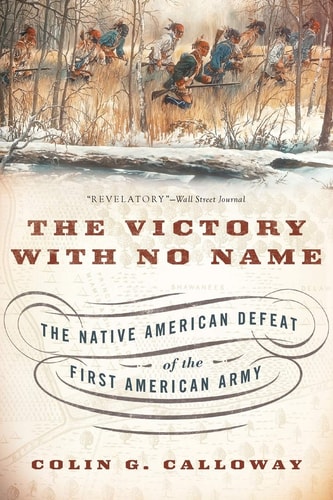
The Victory with No Name: The Native American Defeat of the First American Army
0
0
As an Amazon Associate and affiliate partner, Menrva Books earns from qualifying purchases. Learn more
Author Description
In 1791, General Arthur St. Clair led the United States army in a campaign to destroy a complex of Indian villages at the Maumee River in northwestern Ohio. Almost within reach of their objective, St. Clair's 1,400 men were attacked by about one thousand Indians. The U.S. force was decimated, suffering nearly one thousand casualties in killed and wounded, while Indian casualties numbered only a few dozen. But despite the lopsided result, it wouldn't appear to carry much significance; it involved only a few thousand people, lasted less than three hours, and the outcome, which was never in doubt, was permanently reversed a mere three years later. Neither an epic struggle nor a clash that changed the course of history, the battle doesn't even have a name.Yet, as renowned Native American historian Colin Calloway demonstrates here, St. Clair's Defeat--as it came to be known-- was hugely important for its time. It was both the biggest victory the Native Americans ever won, and, proportionately, the biggest military disaster the United States had suffered. With the British in Canada waiting in the wings for the American experiment in republicanism to fail, and some regions of the West gravitating toward alliance with Spain, the defeat threatened the very existence of the infant United States. Generating a deluge of reports, correspondence, opinions, and debates in the press, it produced the first congressional investigation in American history, while ultimately changing not only the manner in which Americans viewed, raised, organized, and paid for their armies, but the very ways in which they fought their wars.Emphasizing the extent to which the battle has been overlooked in history, Calloway illustrates how this moment of great victory by American Indians became an aberration in the national story and a blank spot in the national memory. Calloway shows that St. Clair's army proved no match for the highly motivated and well-led Native American force that shattered not only
Menrva's Summary
THE THESIS
This work investigates the historical significance of the 1791 Battle of the Wabash, a lopsided military engagement that remains largely absent from the American national consciousness. Colin G. Calloway, a distinguished historian of Native American history, utilizes primary source documents, congressional records, and contemporary correspondence to argue that this defeat was a pivotal moment for the nascent United States. He posits that the disaster forced a fundamental restructuring of American military organization and policy while highlighting the strategic prowess of the Native American confederacy.
THE SCOPE MAP
What You Will Find
- Analysis of the 1791 campaign led by General Arthur St. Clair against Native American villages in the Ohio territory.
- Examination of the political and military consequences for the early American republic.
- Discussion of the first congressional investigation in United States history.
- Exploration of the cultural memory and historical erasure surrounding the event.
Scope Limits
- The text does not provide a comprehensive biography of General Arthur St. Clair.
- It does not offer a detailed tactical breakdown of every minor skirmish in the broader Northwest Indian War.
THE AUTHORITY PERSPECTIVE
Historians and scholars of early American history frequently cite this work for its meticulous archival research and its ability to reframe a neglected event within the broader context of nation-building. Readers often note the academic rigor of the prose, which balances detailed military analysis with broader sociopolitical implications.
Page Count:
224
Publication Date:
2016-09-01
Publisher:
Oxford University Press
ISBN-10:
0190614455
ISBN-13:
9780190614454
History
United States
18th century
Battles
Native American
Military History
Community Tags
Similar Books