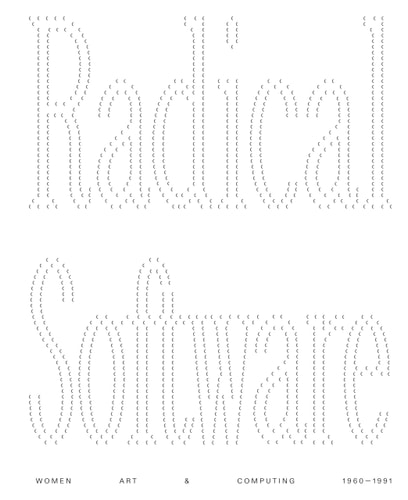
Radical Software: Women, Art & Computing 1960-1991
0
0
As an Amazon Associate and affiliate partner, Menrva Books earns from qualifying purchases. Learn more
Author Description
Radical Software: Women, Art & Computing 1960-1991 surveys the history of digital art from a feminist perspective, focusing on women who worked with computers as a tool or subject and artists who worked in an inherently computational way. Comprising more than 100 works by fifty artists from fourteen countries, it spans a period from the first years of integrated circuit computing in the 1960s to the "microcomputer revolution," which led to the birth of home computing in the 1980s. During these three decades, the computer migrated from the laboratory to private, domestic space. A principally analogue exhibition about digital art, the works on display precede the rise of the World Wide Web and the proliferation of digital information and images that ensued and dramatically reshaped the way artists work to this day. This same period is also referred to as the second wave of feminism, an era that popularised an (albeit incomplete) idea of gender equality. During the 1960s and 1970s, artists, musicians, poets, writers and filmmakers experimented with computer technology. Working in collaboration with mathematicians, computer scientists and engineers, they produced the first computer-generated images, music and texts. By the end of the 1970s, computer technology had been applied in a diverse range of artistic contexts, from the production of drawing and painting to filmmaking and performance. Its influence on contemporary art has been far-reaching, spanning several different artistic movements. Radical Software: Women, Art & Computing 1960-1991 presents work by artists who were amongst the first to use the computer - mainframe and minicomputers - as a tool for artmaking. They are accompanied by other artists who made the computer their subject or worked in a computational way. The exhibition begins with works made in academic or industrial computer labs and ends with others made on the first personal computers in the last years before the internet became public in 1991.
Menrva's Summary
THE THESIS
This book investigates the pioneering role of women in the development of digital art and computing from the 1960s to 1991. It examines how women utilized computers as tools or subjects, and how artists engaged with inherently computational methods. The works presented span three decades, charting the computer's migration from laboratory to domestic space, preceding the World Wide Web. The book contextualizes this artistic evolution within the second wave of feminism, highlighting collaborations between artists and technologists.
THE SCOPE MAP
- Surveys the history of digital art from a feminist perspective.
- Focuses on women who worked with computers as a tool or subject.
- Includes artists who worked in an inherently computational way.
- Features over 100 works by fifty artists from fourteen countries.
- Covers the period from the 1960s (first integrated circuits) to the 1980s (microcomputer revolution).
- Explores the computer's transition from laboratory to private, domestic space.
- Presents works preceding the rise of the World Wide Web and digital proliferation.
THE AUTHORITY PERSPECTIVE
The book offers a comprehensive survey of digital art through a feminist lens, highlighting the contributions of women artists during a pivotal period of technological advancement. It is likely to be appreciated by scholars and enthusiasts of art history, feminist studies, and the history of technology. The focus on the period before the internet's widespread adoption provides a unique perspective on early digital creativity. The exhibition's scope, spanning multiple countries and artistic approaches, suggests a rich and diverse exploration of the subject.
Page Count:
224
Publication Date:
2025-09-23
Publisher:
Verlag der Buchhandlung Walther Konig
ISBN-10:
3753307343
ISBN-13:
9783753307343
Non-Fiction
Art
Art History
Technology and Art
Computer art
Digital art
Community Tags
Similar Books








Reader Comments
Share Your Thoughts
No comments yet. Be the first to share your thoughts!