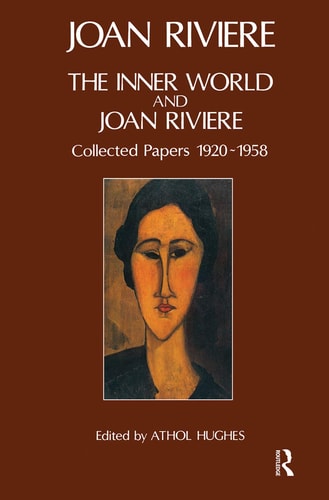
The Inner World and Joan Riviere Collected Papers 1929 - 1958
0
0
As an Amazon Associate and affiliate partner, Menrva Books earns from qualifying purchases. Learn more
Author Description
Joan Riviere was born in Brighton, Sussex, in 1883, and was educated firstly in Brighton itself and then at Wycombe Abbey School, a well-known girls' boarding-school. Although she received no university education, an event of great significance for her later career occurred in her seventeenth year when she was sent to live with a family in Gotha, Germany, in order to acquire proficiency in the German language. In 1906 she married Evelyn Riviere, a barrister at the Chancery bar and son of the successful Victorian painter, Breton Riviere. By 1915 she had entered into analysis with Ernest Jones, and some years later embarked on her first translations of papers by Freud. When the analysis with Jones proved unsatisfactory she became, for a brief period, Freud's analysand. Freud was quick to discern her potential usefulness to the psychoanalytic cause as a sensitive and creative translator, and in 1922 she was appointed Translation Editor of the International Journal of Psycho-Analysis; a position she occupied until 1937. It is uncertain when Joan Riviere and Melanie Klein first met but, by the time Mrs Klein settled in London in 1926, she was already established as an early supporter. In later years Riviere emerged as one of the most articulate proponents of Kleinian ideas, working closely with Mrs. Klein during the 1930s and 1940s, and publishing several papers of her own. A certain coolness, however, developed between Klein and Riviere in the 1950s as Riviere-always uneasy in groups-gradually withdrew from the growing circle of students and supporters who surrounded Klein as her influence and authority made themselves felt. Since her death in 1962, Joan Rivere's reputation has rested principally on her early achievement as a translator and on her later role as a persuasive and lucid disseminator of Freudian and Kleinian ideas. The respect gained for her in these quarters has, however, tended to obscure the importance and originality of her own contributions to psychoan
Menrva's Summary
THE THESIS
This collection presents the seminal papers of Joan Riviere, a pivotal figure in early psychoanalysis, alongside contextual insights into her intellectual world. The volume traces Riviere's development from her early translations of Freud, through her own analytical practice and her close association with Melanie Klein, to her later, more independent contributions. It explores the intellectual landscape of psychoanalysis between 1929 and 1958, a period of intense theoretical development and personal engagement for Riviere, highlighting her role in disseminating and shaping key psychoanalytic ideas.
THE SCOPE MAP
- Collected papers by Joan Riviere spanning the years 1929-1958.
- Biographical information on Joan Riviere, detailing her education, personal life, and entry into psychoanalysis.
- Riviere's early work as a translator of Sigmund Freud's papers.
- Her significant role as Translation Editor of the International Journal of Psycho-Analysis.
- Riviere's development as an early supporter and articulate proponent of Melanie Klein's ideas.
- Analysis of the intellectual and personal dynamics within the psychoanalytic community of the time.
- Exploration of Riviere's own original contributions to psychoanalytic theory.
- Insights into the relationship between Riviere and Melanie Klein, including later divergences.
THE AUTHORITY PERSPECTIVE
This collection offers a comprehensive look at Joan Riviere's significant contributions to psychoanalysis, particularly her role as a translator and disseminator of Freudian and Kleinian thought. The papers themselves are recognized for their clarity and insight, reflecting Riviere's skill in articulating complex psychoanalytic concepts. The biographical context provided helps to situate her work within the broader intellectual and personal landscape of early psychoanalysis. This volume serves as a valuable resource for understanding the evolution of psychoanalytic theory and the key figures who shaped it.
Page Count:
392
Publication Date:
2019-07-05
Publisher:
Taylor & Francis Group
ISBN-10:
0367099721
ISBN-13:
9780367099725
History
Biography
Non-Fiction
Psychology
Psychoanalysis
Community Tags
Similar Books











Reader Comments
Share Your Thoughts
No comments yet. Be the first to share your thoughts!