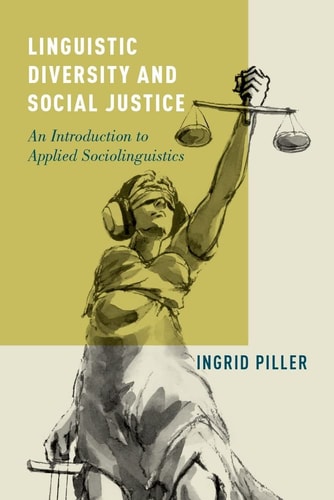
Linguistic Diversity and Social Justice: An Introduction to Applied Sociolinguistics
0
0
As an Amazon Associate and affiliate partner, Menrva Books earns from qualifying purchases. Learn more
Author Description
Understanding and addressing linguistic disadvantage must be a central facet of the social justice agenda of our time. This book explores the ways in which linguistic diversity mediates social justice in liberal democracies undergoing rapid change due to high levels of migration and economic globalization. Focusing on the linguistic dimensions of economic inequality, cultural domination and imparity of political participation, Linguistic Diversity and Social Justice employs a case-study approach to real-world instances of linguistic injustice. Linguistic diversity is a universal characteristic of human language but linguistic diversity is rarely neutral; rather it is accompanied by linguistic stratification and linguistic subordination. Domains critical to social justice include employment, education, and community participation. The book offers a detailed examination of the connection between linguistic diversity and inequality in these specific contexts within nation states that are organized as liberal democracies. Inequalities exist not only between individuals and groups within a state but also between states. Therefore, the book also explores the role of linguistic diversity in global injustice with a particular focus on the spread of English as a global language. While much of the analysis in this book focuses on language as a means of exclusion, discrimination and disadvantage, the concluding chapter asks what the content of linguistic justice might be.
Menrva's Summary
THE THESIS
This book investigates how linguistic diversity functions as a mechanism for social inequality and exclusion within contemporary liberal democracies. Ingrid Piller, a professor of applied linguistics, utilizes a sociolinguistic framework to analyze how language policies and practices contribute to economic, cultural, and political stratification. By examining the intersection of migration, globalization, and language, the author argues that linguistic justice is a necessary component of broader social equity initiatives.
THE SCOPE MAP
What You Will Find
- Analysis of linguistic stratification in employment, education, and community participation.
- Examination of the role of English as a global language in perpetuating international inequality.
- Case studies illustrating real-world instances of linguistic injustice and subordination.
Scope Limits
- The text focuses primarily on liberal democracies rather than authoritarian or non-Western political systems.
- The analysis prioritizes structural and institutional linguistic barriers over individual psychological perspectives.
THE AUTHORITY PERSPECTIVE
Experts recognize this work as a significant contribution to the field of applied sociolinguistics for its clear articulation of the link between language policy and social justice. Readers frequently note that the prose is accessible to students while maintaining the academic rigor required for advanced research in the social sciences.
Page Count:
298
Publication Date:
2016-01-01
Publisher:
Oxford University Press
ISBN-10:
0190614064
ISBN-13:
9780190614065
Globalization
English
Linguistics
Social justice
English & College Success
Professional Career & Trade
Sociology
Applied Linguistics