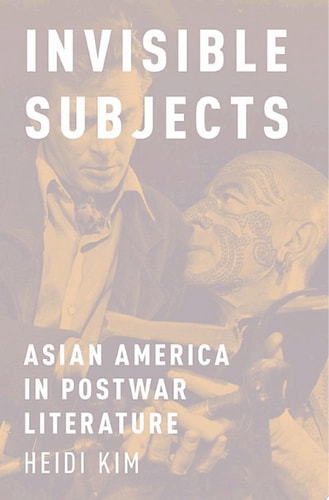
Invisible Subjects: Asian America in Postwar Literature
0
0
As an Amazon Associate and affiliate partner, Menrva Books earns from qualifying purchases. Learn more
Author Description
Invisible Subjects broadens the archive of Asian American studies, using advances in Asian American history and historiography to reinterpret the politics of the major figures of post-World War II American literature and criticism.Taking its theoretical inspiration from the work of Ralph Ellison and his focus on the invisibility of a racial minority in mainstream history, Heidi Kim argues that the work of American studies and literature in this era to explain and contain the troubling Asian figure reflects both the swift amnesia that covers the Pacific theater of WWII and the importance of the Asian to immigration debates and civil rights. From the Melville Revival through the myth and symbol school, as well as the fiction of John Steinbeck and William Faulkner, the postwar literary scene exhibits the ambiguity of Asian forms in the 1950s within the binaries of foreigner/native and black/white, as well as the constructs of gender and the nuclear family. It contrasts with the tortured redefinitions of race and nationality that appear in immigration acts and court cases, particularly those about segregation and interracial marriage. The Melville Revival critics' discussion of a mythic and yet realistic diabolical Asian, the role of a Chinese housekeeper in preserving the pioneer family in Steinbeck's East of Eden, and the extent to which the history of the Mississippi Chinese sheds light on Faulkner's stagnant societies all work to subsume a troubling presence.Detailing the archaeology and genealogy of Asian American Studies, Invisible Subjects offers an original, important, and vital contribution to both our understanding of American literary history and the general study of race and ethnicity in American cultural history.
Menrva's Summary
THE THESIS
How does the postwar American literary canon utilize the figure of the Asian subject to navigate and contain anxieties regarding race, nationality, and civil rights? Heidi Kim, a scholar of Asian American literature and history, examines the intersection of mid-century literary criticism and historical policy. She argues that canonical authors and critics of the 1950s employed specific tropes to manage the presence of Asian figures, effectively rendering them invisible or symbolic to maintain established racial and social binaries.
THE SCOPE MAP
What You Will Find
- Analysis of the Melville Revival and the myth and symbol school of criticism.
- Examination of literary works by John Steinbeck and William Faulkner.
- Integration of legal history, including immigration acts and court cases regarding segregation and interracial marriage.
- Theoretical framework derived from Ralph Ellison’s concept of racial invisibility.
Scope Limits
- The text focuses primarily on the 1950s postwar era rather than contemporary Asian American literature.
- It does not provide an exhaustive survey of all Asian American authors of the period, focusing instead on the representation of Asian figures within mainstream American literature.
THE AUTHORITY PERSPECTIVE
Scholars in the field of American studies recognize this work as a significant contribution to the historiography of Asian American representation. Readers frequently note the academic density of the prose and the precision with which Kim connects literary analysis to historical legal documents.
Page Count:
247
Publication Date:
2016-01-01
Publisher:
Oxford University Press
ISBN-10:
0190614137
ISBN-13:
9780190614133
History
Sociology
English & College Success
Asian American
Modern History
American History
History of the Americas
English
Literary Criticism
Community Tags
Similar Books