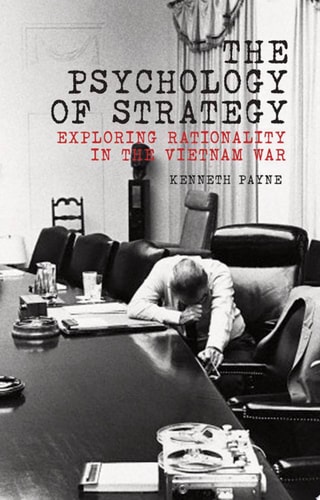
The Psychology of Strategy: Exploring Rationality in the Vietnam War
0
0
As an Amazon Associate and affiliate partner, Menrva Books earns from qualifying purchases. Learn more
Author Description
How do strategists decide what they wish to achieve through war, and how they might accomplish it? And why does their understanding of violence regularly turn out to be wrong? In seeking answers to these questions Kenneth Payne draws on the study of psychology to examine strategic behaviour during the Vietnam War. He explores the ways in which cognitive biases distort our sense of our own agency and our decision-making, arguing that much of the latter is emotional, shaped by unconscious processing and driven by a prickly concern for social esteem.The Nixon and Johnson administrations both proved susceptible to the processes that are familiar to students of modern neuroscience and psychology, but perhaps less appreciated within strategic studies. US strategists in the Vietnam era miscalculated in ways that would surprise rational theorists, but not evolutionary psychologists: they exaggerated the stakes, embraced risky and overly optimistic solutions, and failed to appreciate the limits of force to shatter the enemy's resolve. Their concern for reputation led to escalation, based on a flawed conception of what such escalation could achieve.The Vietnam conflict provides an excellent illustration that war is an inherently psychological phenomenon. This challenges abstract notions of rationality in strategic affairs, suggesting that the strategists -- much like the rest of us -- are strangers to themselves.
Menrva's Summary
THE THESIS
This book investigates why strategic decision-making in the Vietnam War frequently deviated from rational expectations by applying principles of psychology and neuroscience. Kenneth Payne, a scholar in strategic studies, utilizes the historical record of the Johnson and Nixon administrations to argue that strategic behavior is often driven by emotional processing, cognitive biases, and a preoccupation with social esteem rather than purely logical calculations. By examining the failures of US leadership, the author demonstrates how unconscious psychological factors consistently undermined the effectiveness of military and political strategy.
THE SCOPE MAP
What You Will Find
- Analysis of cognitive biases in high-stakes political decision-making
- Application of evolutionary psychology to military strategy
- Examination of the Johnson and Nixon administrations' Vietnam policies
- Discussion on the limitations of force in breaking enemy resolve
Scope Limits
- The text does not provide a comprehensive military history of every battle in the Vietnam War
- It does not offer a general theory of international relations beyond the psychological framework presented
THE AUTHORITY PERSPECTIVE
Experts in strategic studies highlight this work as a significant bridge between neuroscience and traditional military analysis. Readers frequently note the academic density of the prose, which challenges standard rational-actor models used in political science curricula.
Page Count:
222
Publication Date:
2015-01-01
Publisher:
Oxford University Press
ISBN-10:
0190613254
ISBN-13:
9780190613259
Psychology
History
Military History
Vietnam War
Community Tags
Similar Books