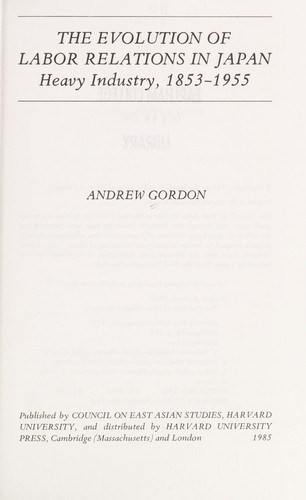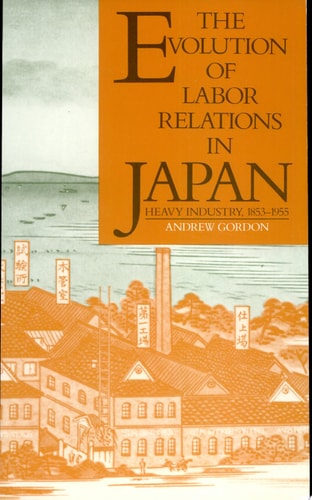
The Evolution of Labor Relations in Japan Heavy Industry, 1853-1955
0
0
As an Amazon Associate and affiliate partner, Menrva Books earns from qualifying purchases. Learn more
Author Description
The century-long process by which a distinct pattern of Japanese labor relations evolved is traced through the often turbulent interactions of workers, managers, and, at times, government bureaucrats and politicians. The author argues that, although by the 1920s labor relations had reached a stage that foreshadowed postwar development, it was not until the 1940s and 1950s that something closely akin to the contemporary pattern emerged. The central theme is that the ideas and actions of the workers, whether unionized or not, played a vital role in the shaping of the system. This is the only study in the West that demonstrates how Japanese workers sought to change and to some extent succeeded in changing the structure of factory life. Managerial innovations and the efforts of state bureaucrats to control social change are also examined. The book is based on extensive archival research and interviewing in Japan, including the use of numerous labor-union publications and the holdings of the prewar elite's principal organization for the study of social issues, the Kyochokai ("Association for Harmonious Cooperation")-both collections having only recently been catalogued and opened to scholars. This is an intensive look at past developments that underlie labor relations in today's Japanese industrial plants.
Menrva's Summary
THE THESIS
This book traces the century-long evolution of Japanese labor relations in heavy industry, focusing on the dynamic interplay between workers, management, and the state. Gordon argues that while early 20th-century developments foreshadowed postwar patterns, the contemporary system only truly emerged in the 1940s and 1950s. The central thesis posits that the agency of workers, both unionized and non-unionized, was crucial in shaping this system. The study highlights the unique contribution of Western scholarship in demonstrating how Japanese workers actively influenced factory life.
THE SCOPE MAP
- The historical development of labor relations in Japanese heavy industry from 1853 to 1955.
- Analysis of the interactions between workers, managers, and government bureaucrats.
- Exploration of the role of worker agency in shaping industrial relations.
- Examination of managerial innovations and state efforts to control social change.
- Insights into the emergence of postwar labor patterns.
- Based on extensive archival research and interviews in Japan.
- Utilizes labor-union publications and the archives of the Kyochokai.
THE AUTHORITY PERSPECTIVE
Andrew Gordon's "The Evolution of Labor Relations in Japan" is recognized as a significant contribution to the study of Japanese industrial history. The book's strength lies in its detailed archival research and its focus on the active role of workers in shaping their own labor conditions. It provides a comprehensive account of the complex factors that led to the distinct pattern of Japanese labor relations, offering valuable insights for scholars of labor history and East Asian studies. The work is considered essential for understanding the historical underpinnings of contemporary Japanese industrial plants.
Page Count:
524
Publication Date:
1988-01-01
Publisher:
Harvard Univ Asia Center
ISBN-10:
0674271319
ISBN-13:
9780674271319
Non-Fiction
History
Industrial Relations
Labor history
Japanese History
Community Tags
Similar Books