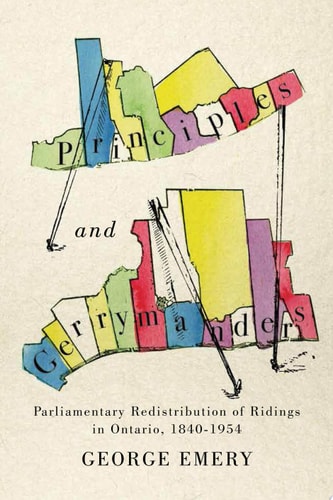
Principles and Gerrymanders: Parliamentary Redistribution of Ridings in Ontario, 1840-1954
0
0
As an Amazon Associate and affiliate partner, Menrva Books earns from qualifying purchases. Learn more
Author Description
Redistributing electoral ridings alters their number, revises their boundaries, or does both at the same time. Ostensibly, the purpose of redistribution is to adjust parliamentary representation for population changes - the growth or decline of population, or shifts in its territorial distribution and social composition. Before an arm's-length commission, headed by a judge, took control of electoral redistribution in the 1960s, parliament - effectively, the majority party - controlled redistribution, raising the possibility that the governing party would adjust the ridings for its own advantage, a practice known as gerrymandering. Providing detailed analyses of parliamentary redistribution in Ontario that preceded the province’s commissioned ridings of the 1960s, George Emery's Principles and Gerrymanders unravels the mechanisms, operational strategies, and exposure to partisanship of parliamentary redistribution and its influence on general election outcomes. Using quantitative research methods, Emery identifies gerrymanders and demonstrates empirically whether or not these worked. He closes with a discussion of the transition to commissioned ridings, what has changed in redistribution, and what continues from the era when parliament redrew ridings. Contextualized with detailed maps and political cartoons, Principles and Gerrymanders is a pioneering study and a major contribution to the literature on Canadian and Ontario political history.
Menrva's Summary
THE THESIS
This book investigates the historical practices of electoral redistribution in Ontario, Canada, from 1840 to 1954, focusing on the potential for partisan manipulation before the establishment of independent commissions. George Emery's work examines the mechanisms, strategies, and partisan influences of parliamentary redistribution, analyzing how these practices affected general election outcomes. The study employs quantitative research methods to identify and assess the effectiveness of gerrymandering during this period. It concludes with an analysis of the shift to commissioned redistribution, highlighting continuities and changes from the era when parliament controlled electoral boundaries.
THE SCOPE MAP
- Detailed analyses of parliamentary redistribution in Ontario between 1840 and 1954.
- Examination of the number and boundaries of electoral ridings.
- Ostensibly neutral purpose of redistribution versus the reality of partisan control.
- Identification and empirical demonstration of gerrymandering tactics.
- Analysis of the influence of redistribution on general election outcomes.
- Discussion of the transition to arm's-length commissions in the 1960s.
- Contextualization with detailed maps and political cartoons.
- Quantitative research methods applied to historical electoral data.
THE AUTHORITY PERSPECTIVE
Principles and Gerrymanders is presented as a pioneering study and a major contribution to the literature on Canadian and Ontario political history. The book's detailed analyses and quantitative approach are highlighted as key strengths in unraveling the complex history of electoral redistribution. Its examination of partisan manipulation and the eventual shift to commissioned ridings offers significant insights into the evolution of electoral processes in Canada. The inclusion of maps and cartoons further enhances its value as a comprehensive historical account.
Page Count:
245
Publication Date:
2015-12-01
Publisher:
McGill-Queen's University Press
ISBN-10:
0773597514
ISBN-13:
9780773597518
History
Non-Fiction
Canadian Politics
Political History
Electoral Systems
Community Tags
Similar Books