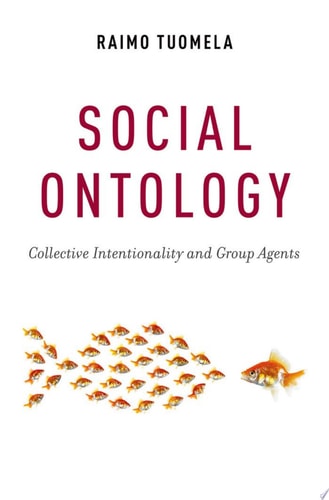
Social Ontology: Collective Intentionality and Group Agents
0
0
As an Amazon Associate and affiliate partner, Menrva Books earns from qualifying purchases. Learn more
Author Description
Social ontology, in its broadest sense, is the study of the nature of social reality, including collective intentions and agency. The starting point of Tuomela's account of collective intentionality is the distinction between thinking and acting as a private person ("I-mode") versus as a "we-thinking" group member ("we-mode"). The we-mode approach is based on social groups consisting of persons, which may range from simple task groups consisting of a few persons to corporations and even to political states. Tuomela extends the we-mode notion to cover groups controlled by external authority. Thus, for instance, cooperation and attitude formation are studied in cases where the participants are governed "from above" as in many corporations.The volume goes on to present a systematic philosophical theory related to the collectivism-versus-individualism debate in the social sciences. A weak version of collectivism (the "we-mode" approach) depends on group-based collective intentionality. We-mode collective intentionality is not individualistically reducible and is needed to complement individualistic accounts in social scientific theorizing. The we-mode approach is used in the book to account for collective intention and action, cooperation, group attitudes, and social practices and institutions, as well as group solidarity. Tuomela establishes the first complete theory of group reasons (in the sense of members' reasons for participation in group activities). The book argues in terms of game-theoretical group-reasoning that the kind of weak collectivism that the we-mode approach involves is both conceptually and rational-functionally different from what an individualistic approach ("pro-group I-mode" approach) entails.
Menrva's Summary
THE THESIS
This work investigates the nature of social reality by examining the distinction between individualistic action and collective intentionality within group agents. Raimo Tuomela, a prominent philosopher of social action, utilizes a rigorous analytical framework to argue that 'we-mode' collective intentionality is not reducible to individualistic accounts. By integrating game-theoretical reasoning, the author establishes a systematic theory of group reasons to explain how social practices, institutions, and group solidarity function in both autonomous and authority-governed settings.
THE SCOPE MAP
What You Will Find
- A formal distinction between I-mode and we-mode agency
- Game-theoretical models of group reasoning and participation
- Analysis of social institutions, cooperation, and attitude formation
- Theoretical arguments regarding the collectivism-versus-individualism debate
Scope Limits
- The text does not provide empirical sociological data or case studies of specific historical organizations
- The focus remains strictly on philosophical and conceptual analysis rather than practical management or policy application
THE AUTHORITY PERSPECTIVE
Experts recognize this volume as a foundational text in the field of social ontology, particularly for its formalization of collective intentionality. Readers frequently note the academic density of the prose, which requires a strong background in analytic philosophy and game theory to fully grasp the author's arguments.
Page Count:
328
Publication Date:
2016-05-15
Publisher:
Oxford University Press
ISBN-10:
019061238X
ISBN-13:
9780190612382
Philosophy
Political Philosophy
Collective Intentionality
Group Identity
Social Groups
Social Science
Community Tags
Other Editions(2)

Similar Books