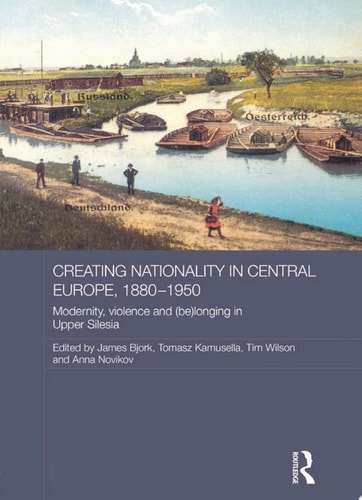
Creating Nationality in Central Europe, 1880-1950
0
0
As an Amazon Associate and affiliate partner, Menrva Books earns from qualifying purchases. Learn more
Author Description
In the immediate aftermath of the First World War, Upper Silesia was the site of the largest formal exercise in self-determination in European history, the 1921 Plebiscite. This asked the inhabitants of Europe’s second largest industrial region the deceptively straightforward question of whether they preferred to be Germans or Poles, but spectacularly failed to clarify their national identity, demonstrating instead the strength of transnational, regionalist and sub-national allegiances, and of allegiances other than nationality, such as religion. As such Upper Silesia, which was partitioned and re-partitioned between 1922 and 1945, and subjected to Czechization, Germanization, Polonization, forced emigration, expulsion and extermination, illustrates the limits of nation-building projects and nation-building narratives imposed from outside. This book explores a range of topics related to nationality issues in Upper Silesia, putting forward the results of extensive new research. It highlights the flaws at the heart of attempts to shape Europe as homogenously national polities and compares the fate of Upper Silesia with the many other European regions where similar problems occurred.
Menrva's Summary
THE THESIS
The 1921 Upper Silesian Plebiscite, a pivotal exercise in post-WWI self-determination, dramatically failed to clarify national identity, revealing the complex interplay of transnational, regionalist, and sub-national allegiances. This book examines the multifaceted nature of nationality in Central Europe between 1880 and 1950, using Upper Silesia as a case study to illustrate the limitations of externally imposed nation-building projects. It delves into the region's turbulent history of partition, assimilation policies, and forced displacement, comparing its fate to other European regions grappling with similar identity crises. The research highlights the inherent flaws in attempts to create homogenous national polities in a diverse continent.
THE SCOPE MAP
- The historical context of the 1921 Upper Silesian Plebiscite and its outcomes.
- Analysis of transnational, regionalist, and sub-national allegiances in Central Europe.
- Exploration of the limits of nation-building projects and externally imposed national narratives.
- Case studies comparing Upper Silesia with other European regions facing similar identity challenges.
- Extensive new research on nationality issues in Upper Silesia from 1880 to 1950.
- Discussion of the impact of assimilation policies such as Czechization, Germanization, and Polonization.
- Examination of forced emigration, expulsion, and extermination in the region.
THE AUTHORITY PERSPECTIVE
The book is likely to be regarded as a significant contribution to the study of nationalism and identity in Central Europe, particularly for its detailed examination of the Upper Silesian case. Its focus on the limitations of nation-building and the complexities of regional and sub-national allegiances suggests a nuanced perspective that challenges simplistic historical narratives. The author's use of extensive new research indicates a scholarly approach, likely appealing to academics and students of history, political science, and European studies.
Page Count:
252
Publication Date:
2016-04-14
Publisher:
Taylor & Francis
ISBN-10:
1317279662
ISBN-13:
9781317279662
History
Politics
Non-Fiction
Identity
Nationalism
Central Europe
Community Tags
Similar Books