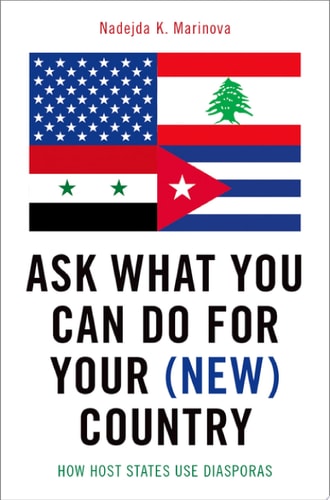
Ask What You Can Do For Your (New) Country: How Host States Use Diasporas
0
0
As an Amazon Associate and affiliate partner, Menrva Books earns from qualifying purchases. Learn more
Author Description
Within recent years a new body of literature has emerged within international relations on transnationalism and foreign policy. This literature has thus far focused on the strategic relationship between home states and their ethnic lobbies abroad, often with regard to remittances to and politics in the home country. This book breaks new ground in that it develops a theory about when, how and for what reasons host states use diasporas and the ethnic lobbies they generate to advance foreign policy goals.Ask What You Can Do for Your (New) Country focuses on a previously unexamined phenomenon: how host governments utilize diasporas to advance their foreign policy agendas in mutually beneficial ways. As was demonstrated in the run-up to the 2003 invasion of Iraq, when Iraqi exiles testified that Saddam Hussein possessed weapons of mass destruction, ethnic lobbies have been utilized strategically by the United States (and other countries) for the promotion of political objectives. Host states have even promoted the creation of such ethnic lobbies for this purpose. As Nadejda K Marinova shows, those who participate in such lobbies are of a particular subset of émigrés who are politically active, express a sustained vision for homeland politics, and who often have existing ties to political institutions within the host state. These groups then act as a link between the public and officials in their home state, and other (generally less politically active) members of the diaspora via a coordinated effort by the host state. She develops a theoretical model for determining the conditions under which a host state will decide to promote and utilize an ethnic lobby, and she tests it against eight cases, including the Bush Administration's use of the American Lebanese Cultural Union and the World Council for the Cedars Revolution in developing policy towards Lebanon and Syria, the Iraqi National Congress in endorsing the US invasion of Iraq, the Cuban-American Committee's cooperat
Menrva's Summary
THE THESIS
This book investigates the strategic mechanisms through which host states mobilize and utilize diaspora populations and ethnic lobbies to advance their own foreign policy objectives. Nadejda K. Marinova, a scholar of international relations, constructs a theoretical framework to explain the conditions under which governments choose to cultivate these groups. By analyzing the intersection of domestic politics and international statecraft, she argues that host states often actively foster ethnic lobbies to serve as conduits for political influence and intelligence.
THE SCOPE MAP
What You Will Find
- A theoretical model for host-state utilization of diaspora groups
- Analysis of the political subset of émigrés who engage in lobbying
- Eight comparative case studies including US policy toward Iraq, Lebanon, and Syria
Scope Limits
- The study does not focus on the perspective of the home state or the impact of remittances
- It does not cover non-political diaspora organizations or social integration issues
THE AUTHORITY PERSPECTIVE
Experts identify this work as a significant contribution to the study of transnationalism and foreign policy. Scholars frequently note the academic rigor of the comparative case studies and the clarity of the theoretical model provided.
Page Count:
360
Publication Date:
2017-07-03
Publisher:
Oxford University Press
ISBN-10:
0190623411
ISBN-13:
9780190623418
International relations
Ethnic Groups
Globalization
Sociology
Immigrants
International Security
Foreign Policy
Community Tags
Similar Books