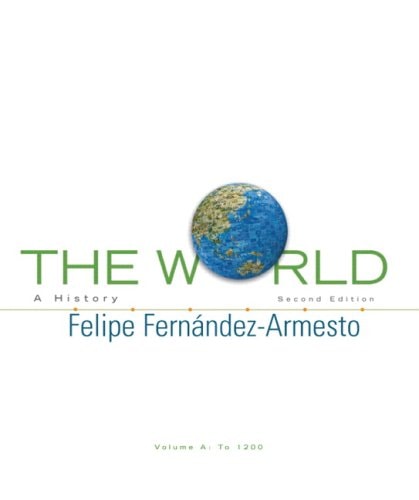
The World: A History, Volume A
0
0
As an Amazon Associate and affiliate partner, Menrva Books earns from qualifying purchases. Learn more
Author Description
The World interweaves two stories–of our interactions with nature and with each other. The environment-centered story is about humans distancing themselves from the rest of nature and searching for a relationship that strikes a balance between constructive and destructive exploitation. The culture-centered story is of how human cultures have become mutually influential and yet mutually differentiating. Both stories have been going on for thousands of years. We do not know whether they will end in triumph or disaster.There is no prospect of covering all of world history in one book. Rather, the fabric of this book is woven from selected strands. Readers will see these at every turn, twisted together into yarn, stretched into stories. Human-focused historical ecology–the environmental theme–will drive readers back, again and again, to the same concepts: sustenance, shelter, disease, energy, technology, art. (The last is a vital category for historians, not only because it is part of our interface with the rest of the world, but also because it forms a record of how we see reality and of how the way we see it changes.) In the global story of human interactions–the cultural theme–we return constantly to the ways people make contact with each another: migration, trade, war, imperialism, pilgrimage, gift exchange, diplomacy, travel–and to their social frameworks: the economic and political arenas, the human groups and groupings, the states and civilizations, the sexes and generations, the classes and clusters of identity.
Menrva's Summary
THE THESIS
How do the dual, interconnected narratives of human interaction with the natural environment and the evolution of cultural exchange define the trajectory of global history? Felipe Fernández-Armesto, a distinguished historian, utilizes a thematic framework to synthesize thousands of years of human experience. By focusing on the tension between environmental exploitation and cultural differentiation, the author argues that history is not a linear progression but a complex, ongoing experiment in survival and mutual influence.
THE SCOPE MAP
What You Will Find
- Analysis of human-focused historical ecology including sustenance, shelter, and energy consumption.
- Examination of cultural contact mechanisms such as migration, trade, war, and diplomacy.
- Investigation of social frameworks including economic systems, political structures, and class identity.
- A thematic approach that prioritizes selected historical strands over a comprehensive chronological catalog.
THE AUTHORITY PERSPECTIVE
This text is regarded as a sophisticated, thematic alternative to traditional chronological surveys, favored for its intellectual breadth and interdisciplinary methodology. The work is widely utilized in academic settings for its ability to synthesize complex environmental and cultural data into a coherent global narrative.
Page Count:
384
Publication Date:
2009-02-02
Publisher:
Pearson
ISBN-10:
0205683479
ISBN-13:
9780205683475
History
World history
Human ecology
Civilization
Academic
Cultural History
Environmental History
Community Tags
Similar Books