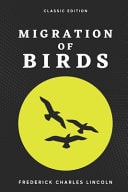
Migration of Birds
0
0
As an Amazon Associate and affiliate partner, Menrva Books earns from qualifying purchases. Learn more
Author Description
As a teenager working at the Colorado Museum of Natural History in 1909, Lincoln learned to prepare specimens from Alexander Wetmore (who was then a student working at the museum) and L. J. Hershey, the museum's Curator of Ornithology.[1][2] Lincoln's interest in birds continued to develop, and he eventually went on to succeed Hershey as curator in 1913, a post which he held until 1920.[1][2] He took time out in 1918-1919 to serve as pigeon expert in the U.S. Army Signal Corps.The professional relationship with Wetmore would continue: the two scientists took field trips together in Washington and Hispaniola and co-wrote eight publications. In 1920, Lincoln joined the U.S. Bureau of Biological Survey (at the time, a unit of the United States Department of Agriculture, and now part of the United States Fish and Wildlife Service and was given the task of organizing and expanding the bird banding program nationwide.The Migratory Bird Treaty Act of 1918 had established federal responsibility for migratory birds; the result was that the North American Bird Banding Program took the place of earlier smaller-scale efforts by individuals and the short-lived American Bird Banding Association. During the period of his tenure, 1920-1946, Lincoln was highly influential: he improved methods for trapping and banding, developed record-keeping procedures, recruited banders, fostered international cooperation, and promoted banding as a tool for research and wildlife management.He proposed a means to estimate the continent-wide population size of a bird species, using reports from hunters and counting "returns" (birds killed that are wearing bands); this metric became known as the Lincoln index. He developed the flyway concept, a key idea in the management and regulation of hunting of migratory birds. Lincoln joined the American Ornithologists' Union in 1910 and was elected a Fellow of the organization in 1934. Lincoln died on 16 September 1960 in Washington, D.C. and was b
Menrva's Summary
THE THESIS
The book details the foundational work and scientific contributions of Frederick C. Lincoln to the study of avian migration and population dynamics. It outlines his early career, his significant role in developing the North American Bird Banding Program, and his innovations in trapping, banding, and record-keeping methods. The text also explores his development of the Lincoln index for population estimation and the influential flyway concept, crucial for wildlife management and hunting regulations.
THE SCOPE MAP
- Frederick C. Lincoln's early career and mentorship under ornithologists.
- The establishment and expansion of the North American Bird Banding Program.
- Improvements in bird trapping and banding techniques.
- Development of record-keeping procedures for banding data.
- The Lincoln index for estimating bird species population size.
- The concept of flyways in migratory bird management.
- Lincoln's professional affiliations and contributions to ornithology.
THE AUTHORITY PERSPECTIVE
This work is presented as a historical account of Frederick C. Lincoln's significant contributions to ornithology and wildlife management. The text focuses on his methodological innovations and conceptual frameworks, such as the Lincoln index and the flyway concept, which were instrumental in advancing the scientific understanding and practical management of migratory birds. The narrative highlights his long tenure organizing the nationwide bird banding program, underscoring his influence on the field. The book appears to be a detailed exploration of a key figure in 20th-century avian research.
Page Count:
116
Publication Date:
2021-05-01
Publisher:
Independently Published
ISBN-13:
9798746990617
Science
Non-Fiction
Bird Watching
Ornithology
Community Tags
Similar Books