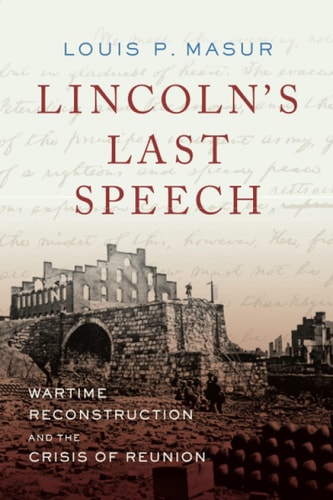
Lincoln's Last Speech
0
0
As an Amazon Associate and affiliate partner, Menrva Books earns from qualifying purchases. Learn more
Author Description
What did Abraham Lincoln envision when he talked about "reconstruction?" Assassinated in 1865, the president did not have a chance to begin the work of reconciling the North and South, nor to oversee Reconstruction as an official postwar strategy. Yet his final speech, given to thousands gathered in the rain outside the White House on April 11, 1865, gives a clear indication of what Lincoln's postwar policy might have looked like-one that differed starkly from what would emerge in the tumultuous decade that followed.In Lincoln's Last Speech, renowned historian and author Louis P. Masur offers insight into this critical address and its vision of a reconstructed United States. Coming two days after Robert E. Lee's surrender at Appomattox and a week after the fall of Richmond, Lincoln's speech was expected to be a victory oration. Instead, he looked to the future, discussing how best to restore the seceded states to the national government, and even endorsing limited black suffrage. Delving into the language and arguments of Lincoln's last address, Masur traces the theme of reconstruction as it developed throughout his presidency, starting with the very earliest days of the war.Masur illuminates the evolution of Lincoln's thinking and the national debate around reconstruction, touching on key moments such as the Proclamation of Amnesty and Reconstruction on December 8, 1863, and Lincoln's pocket veto of the Wade-Davis bill in July 1864. He also examines social reconstruction, including the plight of freedmen and the debate over the place of blacks in society; and considers the implications of Lincoln's speech after April 1865, when Andrew Johnson assumed office and the ground was laid for the most radical phases of the postwar policy. A nuanced study of Lincoln's views on national reconciliation, this work gives us a better understanding of the failures that occurred with postwar Reconstruction and the eventual path that brought the country to reunion.
Menrva's Summary
THE THESIS
This work investigates the specific vision Abraham Lincoln held for the reconstruction of the United States following the Civil War, as articulated in his final public address. Louis P. Masur, a historian specializing in 19th-century American history, utilizes primary source analysis of Lincoln's speeches and legislative actions to argue that the president's postwar policy was distinct from the radical measures implemented by his successor, Andrew Johnson. By examining the evolution of Lincoln's rhetoric from the early war years to his final days, Masur provides a framework for understanding the missed opportunities and political tensions that defined the Reconstruction era.
THE SCOPE MAP
What You Will Find
- Analysis of Lincoln's April 11, 1865, speech regarding postwar policy and black suffrage.
- Historical context of the Proclamation of Amnesty and Reconstruction and the Wade-Davis bill.
- Examination of the transition from Lincoln's administration to the presidency of Andrew Johnson.
Scope Limits
- The text does not provide a comprehensive biography of Lincoln's entire life.
- It does not cover the entirety of the Reconstruction decade in exhaustive detail, focusing primarily on the shift in policy following Lincoln's assassination.
THE AUTHORITY PERSPECTIVE
Historians and scholars recognize this work as a focused, accessible study that clarifies the nuances of Lincoln's political evolution during the final stages of the Civil War. Readers frequently note that the prose is clear and well-suited for both academic study and general historical interest.
Page Count:
264
Publication Date:
2017-03-09
Publisher:
Oxford University Press
ISBN-10:
0190620099
ISBN-13:
9780190620097
History
Biography
Civil War
American History
Reconstruction Era
Community Tags
Other Editions(2)
Similar Books



Reader Comments
Share Your Thoughts
No comments yet. Be the first to share your thoughts!