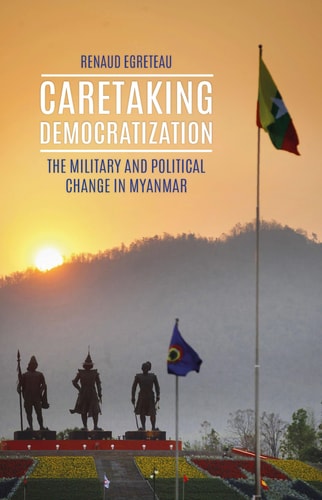
Caretaking Democratization: The Military and Political Change in Myanmar
0
0
As an Amazon Associate and affiliate partner, Menrva Books earns from qualifying purchases. Learn more
Author Description
This book examines the political landscape that took shape in Myanmar after the 2010 elections and the subsequent transition from direct military rule to a quasi-civilian 'hybrid' regime. Striking political, social, and economic transformations have indeed taken place in the long-isolated country since the military junta was disbanded in March 2011. To better construe - and question - what has routinely been labelled a 'Burmese Spring', Egreteau examines the reasons behind the ongoing political transition, as well as the role of the Burmese armed forces in that process, drawing on in-depth interviews with Burmese political actors, party leaders, parliamentarians and retired army officers. The study also takes its cue from comparative scholarship on civil-military relations and post-authoritarian politics, to look at the 'praetorian' logic explaining the transitional moment. Myanmar's road to democratic change is, however, still paved with daunting obstacles. As the book suggests, the continuing military intervention in domestic politics, the resilience of bureaucratic, economic and political clientelism at all levels of society, the iconification of Aung San Suu Kyi, the shadowy influence of regional and global powers, as well as enduring concerns about interethnic and interreligious relations, all are strong reminders of the series of elemental conundrums with which Myanmar will have to deal in order to achieve democratization, sustainable development and peace.
Menrva's Summary
THE THESIS
This book investigates the mechanisms and limitations of Myanmar's political transition from direct military rule to a quasi-civilian hybrid regime following the 2010 elections. Renaud Egreteau, a scholar specializing in Southeast Asian politics, utilizes a framework rooted in comparative civil-military relations to analyze the 'praetorian' logic governing the state. By synthesizing primary source interviews with political actors and military officials, the author evaluates whether the observed changes constitute a genuine democratic shift or a managed transition under continued institutional influence.
THE SCOPE MAP
What You Will Find
- Analysis of the post-2011 political landscape and the disbanding of the military junta.
- Examination of civil-military relations and the role of the armed forces in domestic governance.
- Qualitative data derived from interviews with parliamentarians, party leaders, and retired military personnel.
- Comparative study of post-authoritarian political structures.
Scope Limits
- The analysis focuses primarily on the period immediately following the 2010 elections and the early years of the hybrid regime.
- The text does not provide a comprehensive history of the entire military era prior to 2010.
THE AUTHORITY PERSPECTIVE
Experts identify this work as a significant contribution to the study of Southeast Asian political transitions, noting its rigorous reliance on firsthand accounts from Burmese stakeholders. Readers frequently highlight the author's balanced approach to the complex, often contradictory, nature of Myanmar's institutional reforms.
Page Count:
224
Publication Date:
2016-12-15
Publisher:
Oxford University Press
ISBN-10:
019062096X
ISBN-13:
9780190620967
Burma
International relations
Myanmar
Military History
Asian Studies
Community Tags
Similar Books