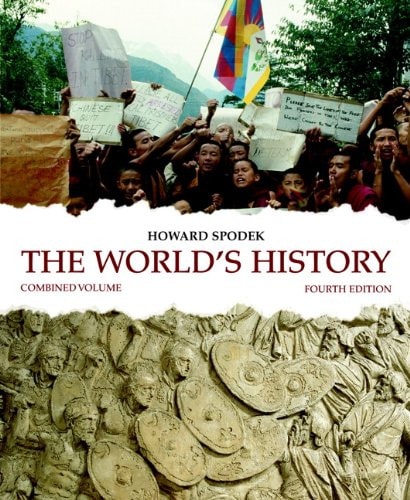
The World's History: Since 1300
0
0
As an Amazon Associate and affiliate partner, Menrva Books earns from qualifying purchases. Learn more
Author Description
The past is not simply a list of events. Historical records are the means by which historians develop their interpretations of those events. Because interpretations differ, there is no single historical record, but various narrations of events each told from a different perspective. Therefore the study of history is intimately linked to the study of values, the values of the historical actors, the historians who have written about them, and of the students engaged in learning about them. The World’s History links chronology, themes, and geography in eight units, or Parts, of study. The Parts move progressively along a time line from the emergence of early humans to the present day. Each Part emphasizes a single theme—for example, urbanization or religion or migration—and students learn to use them all to analyze historical events and to develop a gra
Menrva's Summary
THE THESIS
This text investigates how historical interpretation is shaped by the values of historical actors, historians, and students, rather than viewing history as a static list of events. Howard Spodek, a seasoned historian and educator, utilizes a thematic and geographical framework to organize the vast timeline of human development. By linking chronology with specific thematic lenses, the author provides a methodology for students to analyze historical narratives critically and understand the subjective nature of historical record-keeping.
THE SCOPE MAP
What You Will Find
- A chronological progression from early human emergence to the present day.
- Eight distinct thematic units focusing on concepts such as urbanization, religion, and migration.
- A comparative geographical approach that examines global interactions over time.
- Methodological tools for evaluating primary sources and diverse historical perspectives.
THE AUTHORITY PERSPECTIVE
This work is regarded as a comprehensive pedagogical tool designed for undergraduate-level world history courses. The framing suggests a structured, academic approach that prioritizes analytical skill-building over rote memorization of dates and names.
Page Count:
488
Publication Date:
2010-01-02
Publisher:
Pearson
ISBN-10:
0205708374
ISBN-13:
9780205708376
History
textbook
World history
Education
Community Tags
Similar Books