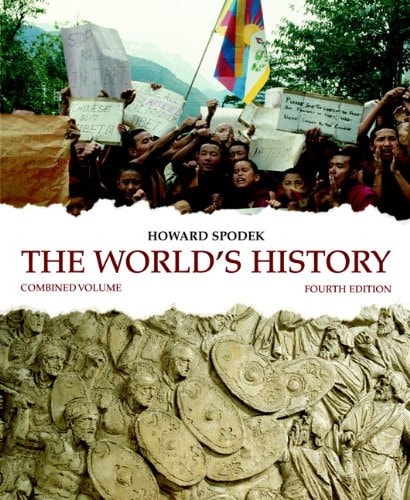
The World's History
0
0
As an Amazon Associate and affiliate partner, Menrva Books earns from qualifying purchases. Learn more
Author Description
The past is not simply a list of events. Historical records are the means by which historians develop their interpretations of those events. Because interpretations differ, there is no single historical record, but various narrations of events each told from a different perspective. Therefore the study of history is intimately linked to the study of values, the values of the historical actors, the historians who have written about them, and of the students engaged in learning about them.The World’s History links chronology, themes, and geography in eight units, or Parts, of study. The Parts move progressively along a time line from the emergence of early humans to the present day. Each Part emphasizes a single theme—for example, urbanization or religion or migration—and students learn to use them all to analyze historical events and to develop a grasp of the chronology of human development. The final chapter employs all the themes developed in the first seven Parts as tools for understanding the history of our own times. Geographically, each Part covers the entire globe, although specific topics place greater emphasis on specific regions.
Menrva's Summary
THE THESIS
This text investigates the core question of how historical interpretation is shaped by the values of both the actors involved and the historians who document them. Howard Spodek, a seasoned historian and educator, utilizes a thematic and geographic framework to move beyond a mere chronological list of events. By organizing human history into eight distinct units, the author provides a methodology for students to analyze the development of human civilization through specific lenses such as urbanization, religion, and migration.
THE SCOPE MAP
What You Will Find
- A comprehensive chronological timeline spanning from the emergence of early humans to the contemporary era.
- A thematic analytical framework that applies specific lenses like migration and urbanization to global history.
- A comparative geographic approach that balances regional focus with a global perspective.
- Pedagogical tools designed to help students synthesize multiple historical themes to interpret modern events.
THE AUTHORITY PERSPECTIVE
This work is regarded as a structured, academic resource that prioritizes thematic synthesis over rote memorization. The framing suggests a dense, pedagogical approach intended for undergraduate students seeking a holistic understanding of global historical development.
Page Count:
968
Publication Date:
2010-01-02
Publisher:
Pearson
ISBN-10:
0205708390
ISBN-13:
9780205708390
History
World history
textbook
Education
Community Tags
Similar Books