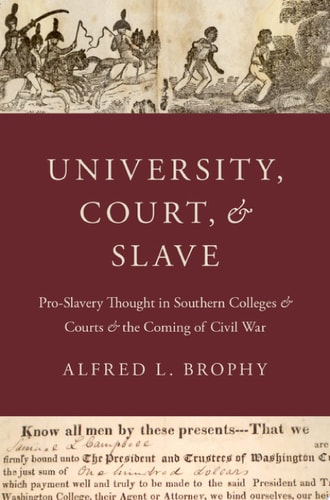
University, Court, and Slave: Proslavery Academic Thought and Southern Jurisprudence, 1831-1861
0
0
As an Amazon Associate and affiliate partner, Menrva Books earns from qualifying purchases. Learn more
Author Description
Alfred L. Brophy's University, Court, and Slave reveals long-forgotten connections between pre-Civil War southern universities and slavery. Universities and their faculty owned people -- sometimes dozens of people -- and profited from their labor while many were physically abused on their campuses. Education was often paid for through the profits of enslaved labor. University faculty -- and students -- also promoted the institution of slavery. They wrote about the history of slavery, its central role in the southern economy, and developed a political theory that justified keeping some people in slavery. The university faculty spoke a common language of economic utility, history, and philosophy with those who made the laws for the southern states. That extensive writing promoting slavery helps us understand how southern politicians and judges thought about slavery. As antislavery rhetoric gained momentum, southern academics and their allies in the courts became bolder in their claims. Some went so far as to say that slavery was supported by natural law. The combination of economic reasoning and historical precedent helped shape a southern, proslavery jurisprudence. Following Lincoln's November 1860 election southern academics joined politicians, judges, lawyers, and other leaders to argue that their economy and society was threatened. Southern jurisprudence led them to believe that any threats to slavery and property justified secession. In some cases, academics took their case to the southern public and, in one case, to the battlefield, to defend slavery.
Menrva's Summary
THE THESIS
This work investigates how antebellum southern academic institutions and their faculty provided the intellectual and legal framework that justified the institution of slavery. Alfred L. Brophy examines the symbiotic relationship between university scholarship and the southern legal system, demonstrating how faculty members utilized economic theory, history, and philosophy to construct a defense of slavery. By analyzing the writings of academics alongside the decisions of southern courts, the author illustrates how these ideas permeated the political landscape and ultimately influenced the push toward secession.
THE SCOPE MAP
What You Will Find
- Analysis of the economic and philosophical arguments used by southern academics to defend slavery.
- Examination of the direct financial ties between universities and enslaved labor.
- Exploration of the intersection between academic discourse and southern jurisprudence.
Scope Limits
- The study is strictly confined to the period between 1831 and 1861.
- It does not provide a comprehensive history of all southern universities, focusing instead on those with significant influence on legal and political thought.
THE AUTHORITY PERSPECTIVE
Scholars recognize this text as a significant contribution to the understanding of how intellectual institutions sustained the institution of slavery in the American South. Readers frequently note the meticulous archival research that links academic output to specific legal outcomes in the decades preceding the Civil War.
Page Count:
0
Publication Date:
2016-01-01
Publisher:
Oxford University Press
ISBN-10:
0190625937
ISBN-13:
9780190625931
History
Academic History
Southern History
American History
Legal History
Slavery
Community Tags
Similar Books