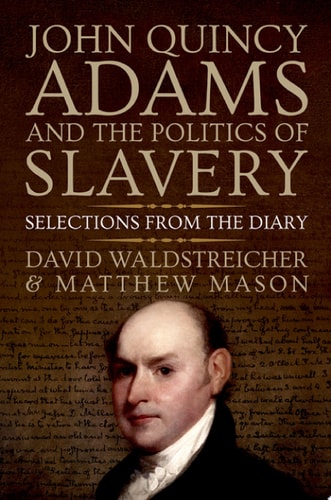
John Quincy Adams and the Politics of Slavery: Selections from the Diary
0
0
As an Amazon Associate and affiliate partner, Menrva Books earns from qualifying purchases. Learn more
Author Description
In the final years of his political career, President John Quincy Adams was well known for his objections to slavery, with rival Henry Wise going so far as to label him "the acutest, the astutest, the archest enemy of southern slavery that ever existed." As a young statesman, however, he supported slavery. How did the man who in 1795 told a British cabinet officer not to speak to him of "the Virginians, the Southern people, the democrats," whom he considered "in no other light than as Americans," come to foretell "a grand struggle between slavery and freedom"? How could a committed expansionist, who would rather abandon his party and lose his U.S. Senate seat than attack Jeffersonian slave power, later come to declare the Mexican War the "apoplexy of the Constitution," a hijacking of the republic by slaveholders? What changed? Entries from Adams's personal diary, more extensive than that of any American statesman, reveal a highly dynamic and accomplished politician in engagement with one of his generation's most challenging national dilemmas. Expertly edited by David Waldstreicher and Matthew Mason, John Quincy Adams and the Politics of Slavery offers an unusual perspective on the dramatic and shifting politics of slavery in the early republic, as it moved from the margins to the center of public life and from the shadows to the substance of Adams's politics. The editors provide a lucid introduction to the collection as a whole and frame the individual documents with brief and engaging insights, rendering both Adams's life and the controversies over slavery into a mutually illuminating narrative. By juxtaposing Adams's personal reflections on slavery with what he said-and did not say-publicly on the issue, the editors offer a nuanced portrait of how he interacted with prevailing ideologies during his consequential career and life. John Quincy Adams and the Politics of Slavery is an invaluable contribution to our understanding of the complicated politics of slavery.
Menrva's Summary
THE THESIS
This volume investigates the ideological transformation of John Quincy Adams from a supporter of slavery to one of its most vocal political opponents. Editors David Waldstreicher and Matthew Mason utilize Adams's extensive personal diary entries to analyze how his private reflections and public actions shifted in response to the growing national crisis over slavery. By juxtaposing these private writings with his public record, the authors provide a framework for understanding the complex evolution of political thought in the early American republic.
THE SCOPE MAP
What You Will Find
- Selected diary entries from John Quincy Adams spanning his political career.
- Editorial commentary framing the historical context of each document.
- Analysis of the transition of slavery from a marginal issue to the center of American political life.
Scope Limits
- The text does not provide a comprehensive biography of Adams's entire life.
- It focuses primarily on the intersection of his career and the politics of slavery rather than his broader diplomatic or personal history.
THE AUTHORITY PERSPECTIVE
Scholars and historians recognize this collection as a vital resource for understanding the internal contradictions of early American political figures. Readers frequently note that the editorial framing provides necessary clarity for navigating the dense, primary source material.
Page Count:
334
Publication Date:
2016-01-01
Publisher:
Oxford University Press
ISBN-10:
0190624612
ISBN-13:
9780190624613
History
Biography
Slavery
Primary Sources
American History
United States
Community Tags
Similar Books





Reader Comments
Share Your Thoughts
No comments yet. Be the first to share your thoughts!