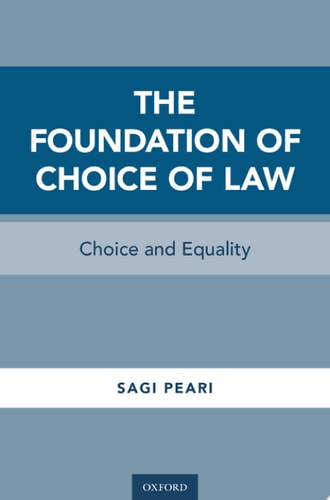
The Foundation of Choice of Law Choice and Equality
0
0
As an Amazon Associate and affiliate partner, Menrva Books earns from qualifying purchases. Learn more
Author Description
This book focuses on the subject of choice of law as a whole and provides an analysis of its various rules, principles, doctrines, and concepts. It offers a conceptual account of choice of law, called "choice equality foundation" (CEF), which aims to flesh out the normative basis of the subject. This book reveals that, despite the multiplicity of titles and labels within the myriad choice-of-law rules and practices of the US, Canadian, European, and other systems, many of them effectively confirm and crystallize CEF's vision of the subject. This alignment signifies the necessarily intimate relationship between theory and practice, whereby the normative underpinnings of CEF are deeply embedded and reflected in actual practical reality. Among other things, this book provides a justification for the nature (and limits) of such popular principles as "party autonomy," "most significant relationship," and "closest connection" (Chapters 2 and 3), discusses such topics as the actual operation of "public policy" doctrine in domestic courts (Chapter 4) and the relation between the notion of international human rights and international commercial dealings (Chapter 5), and makes some suggestions about the ability of traditional rules to cope with the advancing challenges of the digital age (Chapter 6)
Menrva's Summary
THE THESIS
This book investigates the normative foundations of choice of law rules by proposing the 'choice equality foundation' (CEF) as a unifying conceptual framework. Sagi Peari, a scholar in private international law, utilizes a comparative analysis of legal systems in the United States, Canada, and Europe to argue that diverse choice-of-law doctrines are anchored in a shared normative vision. By examining the intersection of theory and practice, the author seeks to provide a coherent justification for established legal principles and their application in modern judicial settings.
THE SCOPE MAP
What You Will Find
- A conceptual framework titled 'choice equality foundation' (CEF).
- Analysis of legal doctrines including 'party autonomy,' 'most significant relationship,' and 'closest connection.'
- Examination of the 'public policy' doctrine in domestic courts.
- Discussion on the intersection of international human rights and commercial law.
- Evaluation of traditional legal rules in the context of the digital age.
Scope Limits
- The text does not provide a comprehensive survey of every global jurisdiction, focusing primarily on Western legal systems.
- It does not serve as a procedural manual for practicing attorneys but rather as a theoretical treatise on legal foundations.
THE AUTHORITY PERSPECTIVE
Legal scholars and practitioners identify this work as a significant contribution to the theoretical understanding of private international law. Readers frequently note the academic density of the prose, which is intended for an audience familiar with comparative legal analysis and jurisprudence.
Page Count:
316
Publication Date:
2018-01-01
Publisher:
Oxford University Press
ISBN-10:
0190622334
ISBN-13:
9780190622336
Law
Jurisprudence
International Law
Legal Theory
Conflict of Laws
Community Tags
Similar Books