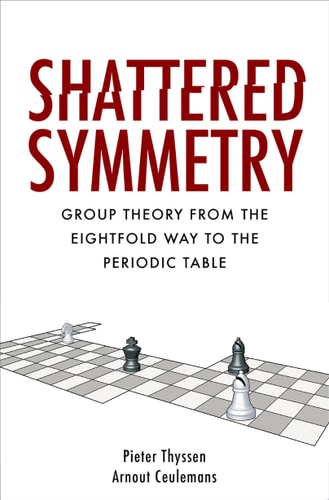
Shattered Symmetry: Group Theory From the Eightfold Way to the Periodic Table
0
0
As an Amazon Associate and affiliate partner, Menrva Books earns from qualifying purchases. Learn more
Author Description
Symmetry is at the heart of our understanding of matter. This book tells the fascinating story of the constituents of matter from a common symmetry perspective. The standard model of elementary particles and the periodic table of chemical elements have the common goal to bring order in the bewildering chaos of the constituents of matter. Their success relies on the presence of fundamental symmetries in their core. The purpose of Shattered Symmetry is to share the admiration for the power and the beauty of these symmetries. The reader is taken on a journey from the basic geometric symmetry group of a circle to the sublime dynamic symmetries that govern the motions of the particles. Along the way the theory of symmetry groups is gradually introduced with special emphasis on its use as a classification tool and its graphical representations. This is applied to the unitary symmetry of the eightfold way of quarks, and to the four-dimensional symmetry of the hydrogen atom. The final challenge is to open up the structure of Mendeleev's table which goes beyond the symmetry of the hydrogen atom. Breaking this symmetry to accommodate the multi-electron atoms requires us to leave the common ground of linear algebras and explore the potential of non-linearity.
Menrva's Summary
THE THESIS
This book investigates the fundamental role of symmetry in organizing the constituents of matter, specifically examining how group theory bridges the gap between elementary particle physics and the periodic table of chemical elements. Authors Arnout Ceulemans and Pieter Thyssen utilize their expertise in theoretical chemistry and physics to construct a framework that connects geometric symmetry groups to the dynamic behaviors of subatomic particles. By tracing the evolution of symmetry from basic circles to complex unitary and four-dimensional systems, the authors argue that symmetry serves as the primary classification tool for understanding physical reality. The text synthesizes historical developments in particle physics with the structural challenges inherent in multi-electron atomic models.
THE SCOPE MAP
What You Will Find
- Introduction to symmetry group theory and its mathematical foundations
- Application of unitary symmetry to the eightfold way of quarks
- Analysis of the four-dimensional symmetry governing the hydrogen atom
- Exploration of non-linear algebra in the context of Mendeleev's periodic table
Scope Limits
- The text does not provide a comprehensive history of all chemical discoveries
- It assumes a foundational understanding of linear algebra and quantum mechanics
THE AUTHORITY PERSPECTIVE
Experts recognize this work as a specialized bridge between particle physics and chemical theory, noting its utility for students and researchers interested in the mathematical underpinnings of matter. Readers frequently highlight the technical density of the prose, which requires a solid grasp of undergraduate-level physics and mathematics to fully comprehend the arguments presented.
Page Count:
521
Publication Date:
2017-01-01
Publisher:
Oxford University Press
ISBN-10:
019062017X
ISBN-13:
9780190620172
Science
Inorganic Chemistry
Mathematics
Group Theory
Lie Algebras
Chemistry
Physics
Earth Sciences
Periodic Law
Physical Chemistry
Community Tags
Similar Books