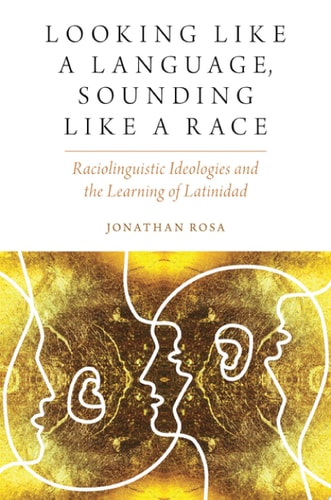
Looking Like a Language, Sounding Like a Race
0
0
As an Amazon Associate and affiliate partner, Menrva Books earns from qualifying purchases. Learn more
Author Description
Looking Like A Language, Sounding Like A Race examines the emergence of linguistic and ethnoracial categories in the context of Latinidad. The book draws from more than twenty-four months of ethnographic and sociolinguistic fieldwork in a Chicago public school, whose student body is more than 90% Mexican and Puerto Rican, to analyze the racialization of language and its relationship to issues of power and national identity. It focuses specifically on youth socialization to U.S. Latinidad as a contemporary site of political anxiety, raciolinguistic transformation, and urban inequity. Jonathan Rosa's account studies the fashioning of Latinidad in Chicago's highly segregated Near Northwest Side; he links public discourse concerning the rising prominence of U.S. Latinidad to the institutional management and experience of raciolinguistic identities there. Anxieties surrounding Latinx identities push administrators to transform at risk Mexican and Puerto Rican students into young Latino professionals. This institutional effort, which requires students to learn to be and, importantly, sound like themselves in highly studied ways, reveals administrators' attempts to navigate a precarious urban terrain in a city grappling with some of the nation's highest youth homicide, dropout, and teen pregnancy rates. Rosa explores the ingenuity of his research participants' responses to these forms of marginalization through the contestation of political, ethnoracial, and linguistic borders.
Menrva's Summary
THE THESIS
How do institutional practices and public discourse construct the intersection of linguistic performance and ethnoracial identity for Latinx youth in urban environments? Jonathan Rosa, an anthropologist and linguist, utilizes over two years of ethnographic fieldwork within a Chicago public school to investigate the concept of raciolinguistic ideologies. He argues that schools function as sites where political anxieties regarding Latinidad are managed through the regulation of how students speak and present themselves, ultimately linking these local school experiences to broader national identity politics.
THE SCOPE MAP
What You Will Find
- Ethnographic data from a Chicago public school with a predominantly Mexican and Puerto Rican student population
- Analysis of raciolinguistic socialization and the institutional management of identity
- Examination of the tension between student agency and administrative efforts to mold professional identities
- Discussion of urban inequality, including dropout rates and youth violence
Scope Limits
- The study is geographically confined to a specific neighborhood in Chicago
- The research focuses primarily on the experiences of Mexican and Puerto Rican youth rather than all Latinx demographics
THE AUTHORITY PERSPECTIVE
Scholars in the fields of linguistic anthropology and education frequently cite this work as a critical examination of how language serves as a proxy for racial categorization. Readers often note the academic rigor of the text, highlighting its effectiveness in demonstrating how institutional policies can marginalize students by policing their speech patterns.
Page Count:
304
Publication Date:
2018-01-01
Publisher:
Oxford University Press
ISBN-10:
019063474X
ISBN-13:
9780190634742
Ethnic Studies
Education
Linguistics
Sociology
Latinx Studies
Anthropology
Community Tags
Similar Books