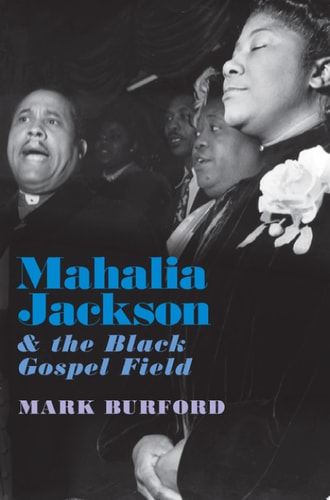
Mahalia Jackson and the Black Gospel Field
0
0
As an Amazon Associate and affiliate partner, Menrva Books earns from qualifying purchases. Learn more
Author Description
Nearly a half century after her death in 1972, Mahalia Jackson remains the most esteemed figure in black gospel music history. Born in the backstreets of New Orleans in 1911, Jackson during the Great Depression joined the Great Migration to Chicago, where she became an highly regarded church singer and, by the mid-fifties, a coveted recording artist for Apollo and Columbia Records, lauded as the "World's Greatest Gospel Singer."This "Louisiana Cinderella" narrative of Jackson's career during the decade following World War II carried important meanings for African Americans, though it remains a story half told. Jackson was gospel's first multi-mediated artist, with a nationally broadcast radio program, a Chicago-based television show, and early recordings that introduced straight-out-of-the-church black gospel to American and European audiences while also tapping the vogue for religious pop in the early Cold War. In some ways, Jackson's successes made her an exceptional case, though she is perhaps best understood as part of broader developments in the black gospel field. Built upon foundations laid by pioneering Chicago organizers in the 1930s, black gospel singing, with Jackson as its most visible representative, began to circulate in novel ways as a form of popular culture in the 1940s and 1950s, its practitioners accruing prestige not only through devout integrity but also from their charismatic artistry, public recognition, and pop-cultural cachet. These years also saw shifting strategies in the black freedom struggle that gave new cultural-political significance to African American vernacular culture.The first book on Jackson in 25 years, Mahalia Jackson and the Black Gospel Field draws on a trove of previously unexamined archival sources that illuminate Jackson's childhood in New Orleans and her negotiation of parallel careers as a singing Baptist evangelist and a mass media entertainer, documenting the unfolding material and symbolic influence of Jackson and b
Menrva's Summary
THE THESIS
This work investigates how Mahalia Jackson functioned as both a devout evangelist and a mass-media entertainer to define the trajectory of black gospel music in the mid-twentieth century. Mark Burford, a musicologist, utilizes extensive archival research to examine the intersection of Jackson's career with the broader development of the black gospel field. The text argues that Jackson’s success was not merely an individual achievement but a reflection of shifting cultural strategies within the African American freedom struggle and the rise of gospel as a popular commercial genre.
THE SCOPE MAP
What You Will Find
- Analysis of Jackson’s early life in New Orleans and her migration to Chicago.
- Examination of the commercialization of gospel through radio, television, and recording contracts.
- Contextualization of gospel music within the post-World War II American cultural landscape.
- Discussion of the interplay between religious integrity and pop-cultural prestige.
Scope Limits
- The text focuses primarily on the period between the 1930s and the mid-1950s.
- It does not provide an exhaustive discography or a comprehensive biography of Jackson's final years.
THE AUTHORITY PERSPECTIVE
Scholars and music historians recognize this work as a significant contribution to the study of gospel music, particularly for its use of previously unexamined archival materials. Readers frequently note the academic rigor and the depth of the author's analysis regarding the commercial and political dimensions of Jackson's career.
Page Count:
496
Publication Date:
2018-12-07
Publisher:
Oxford University Press
ISBN-10:
0190634901
ISBN-13:
9780190634902
Biography
African Americans
African American
Singers
Cultural History
Gospel Music
Musical Genres
New Used & Rental Textbooks
Music History
United States
Community Tags
Other Editions(4)


Similar Books














Reader Comments
Share Your Thoughts
No comments yet. Be the first to share your thoughts!