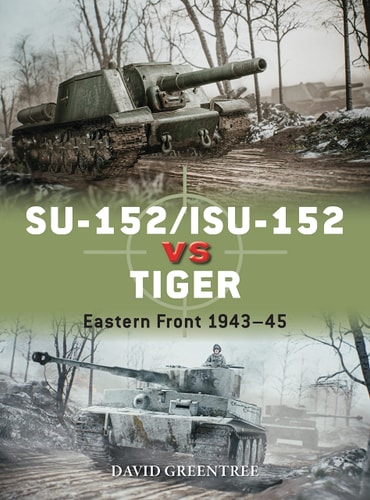
SU-152/ISU-152 Vs Tiger Eastern Front 1943–45
0
0
As an Amazon Associate and affiliate partner, Menrva Books earns from qualifying purchases. Learn more
Author Description
This fully illustrated volume compares two of the most iconic AFV's: the SU-152/ISU-152 and the Tiger, used on the Eastern Front during World War II. On the Eastern Front in 1943, the Tiger-equipped heavy Panzer battalions gave German armored divisions an unmatched capability that cost the Red Army dearly. The Tiger's 88mm gun carved through Soviet defenses in the attack, and caused havoc amongst advancing Soviet armored formations when used in defense. Neither of the Red Army's heavy tanks (the KV-1 and KV-2) could match the Tiger's gun, and, more importantly, penetrate its armor at anything approaching standard combat range. The Soviet response was a stopgap vehicle that mounted a 152mm artillery piece onto the KV tank's chassis: the SU-152. This fascinating volume describes how the SU-152 was first deployed at Kursk in 1943, where its shell proved capable of killing Tigers, and documents its evolution into the ISU-152 in late 1943 (the latter carried the same gun on an IS chassis, and featured increased frontal armor). Packed with superb illustrations, it also explores the widely differing tactical employment of these two iconic AFVs, unit organization, equipment and weaponry, and crew roles.
Menrva's Summary
THE THESIS
This volume investigates the comparative effectiveness and tactical deployment of the SU-152/ISU-152 and the German Tiger tank on the Eastern Front between 1943 and 1945. David Greentree, an author with a focus on military history and armored vehicles, analyzes the strategic context of the Eastern Front where German heavy tanks initially dominated Soviet forces. The book details the development of the SU-152 as a Soviet response to the Tiger's formidable armament and armor, tracing its evolution into the ISU-152 and comparing their capabilities and operational histories.
THE SCOPE MAP
- A detailed comparison of the SU-152/ISU-152 and the German Tiger tank.
- Analysis of their use on the Eastern Front from 1943 to 1945.
- Discussion of the Soviet response to German armored superiority, including the development of the SU-152.
- Examination of the evolution from the SU-152 to the ISU-152.
- Exploration of tactical employment, unit organization, equipment, weaponry, and crew roles for both AFVs.
- Coverage of key engagements such as the Battle of Kursk.
THE AUTHORITY PERSPECTIVE
The book is presented as a comparative study of two iconic World War II armored fighting vehicles. Its focus on the Eastern Front and the specific period of 1943-1945 suggests a detailed examination of tank warfare during a critical phase of the conflict. The inclusion of illustrations and analysis of tactical employment, unit organization, and crew roles indicates a comprehensive approach for enthusiasts of military history and armored vehicles.
Page Count:
80
Publication Date:
2022-04-26
Publisher:
Bloomsbury USA
ISBN-10:
1472848640
ISBN-13:
9781472848642
Non-Fiction
History
Military History
Armor
Vehicles
Community Tags
Similar Books