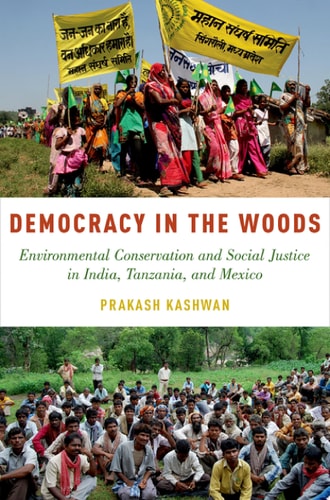
Democracy in the Woods: Environmental Conservation and Social Justice in India, Tanzania, and Mexico
0
0
As an Amazon Associate and affiliate partner, Menrva Books earns from qualifying purchases. Learn more
Author Description
How do societies negotiate the apparently competing agendas of environmental protection and social justice? Why do some countries perform much better than others on this front?Democracy in the Woods addresses these question by examining land rights conflicts-and the fate of forest-dependent peasants-in the context of the different forest property regimes in India, Tanzania, and Mexico. These three countries are prominent in the scholarship and policy debates about national forest policies and land conflicts associated with international support for nature conservation. This unique comparative study of national forestland regimes challenges the received wisdom that redistributive policies necessarily undermine the goals of environmental protection. It shows instead that the form that national environmental protection efforts take - either inclusive (as in Mexico) or exclusive (as in Tanzania and, for the most part, in India) - depends on whether dominant political parties are compelled to create structures of political intermediation that channel peasant demands for forest and land rights into the policy process. This book offers three different tests of this theory of political origins of forestland regimes. First, it explains why it took the Indian political elites nearly sixty years to introduce meaningful reforms of the colonial-era forestland regimes. Second, it successfully explains the rather counterintuitive local outcomes of the programs for formalization of land rights in India, Tanzania, and Mexico. Third, it provides a coherent explanation of why each of these three countries proposes a significantly different distribution of the benefits of forest-based climate change mitigation programs being developed under the auspices of the United Nations.In its political analysis of the control over and the use of nature, this book opens up new avenues for reflecting on how legacies of the past and international interventions interject into domestic political proce
Menrva's Summary
THE THESIS
This book investigates the political conditions under which environmental conservation policies either align with or undermine social justice for forest-dependent populations. Author Prakash Kashwan, a scholar of political science and environmental policy, utilizes a comparative framework to analyze how national political structures in India, Tanzania, and Mexico dictate the inclusivity of forestland management. He argues that the success of equitable conservation depends on whether dominant political parties are incentivized to integrate peasant demands into the formal policy-making process.
THE SCOPE MAP
What You Will Find
- Comparative analysis of forest property regimes across three distinct national contexts.
- A theoretical framework linking political intermediation to environmental policy outcomes.
- Evaluation of international climate change mitigation programs and their local distributive effects.
Scope Limits
- The study focuses primarily on national-level political structures rather than granular ecological data.
- It does not provide an exhaustive history of all environmental movements within the three countries.
THE AUTHORITY PERSPECTIVE
Scholars in the field of political ecology and environmental governance recognize this work as a rigorous comparative study that challenges conventional assumptions about the trade-offs between conservation and social equity. Readers frequently note the academic density of the prose, which is well-suited for researchers and policy analysts interested in the intersection of land rights and state power.
Page Count:
333
Publication Date:
2017-01-01
Publisher:
Oxford University Press
ISBN-10:
0190637404
ISBN-13:
9780190637408
Nature
Social justice
Comparative Politics
Conservation
Land Rights
Public Policy
International relations
Politics & Government
Peasants_india
Sociology
Rural
Community Tags
Other Editions(2)
Similar Books










Reader Comments
Share Your Thoughts
No comments yet. Be the first to share your thoughts!