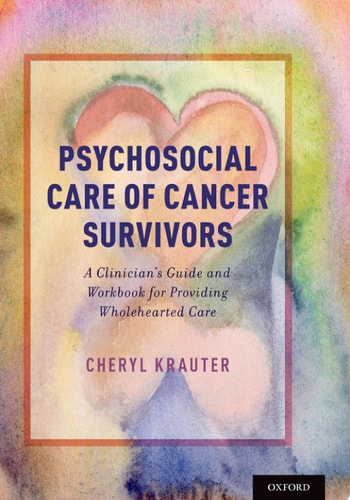
Psychosocial Care of Cancer Survivors: A Clinician's Guide and Workbook for Providing Wholehearted Care
0
0
As an Amazon Associate and affiliate partner, Menrva Books earns from qualifying purchases. Learn more
Author Description
Currently there is a crisis occurring in healthcare involving clinician burnout, emotional exhaustion, lack of inspiration, and loss of personal meaning. For clinicians caring for cancer survivors, these feelings are aggravated by facing the largely unknown realm of survivorship and the issues it brings to patients and clinicians alike. As the number of cancer survivors grows, psychosocial oncology clinicians are increasingly called upon to work with the long-term aftermath of a cancer diagnosis, which requires the capacity to address the emotional and psychosocial issues that are not part of a traditional medical education. Clinicians have plenty of textbooks, but fewer hands-on, interactive guides that teach these kinds of experiential lessons that can be used in their day-to-day work lives. This accessible workbook offers a way to think about these important ideas while providing a structure to implement humanistic clinical practices. Clinical skills, communication tools, empathy as a learned capacity, cultural humility, reflective and mindful exercises designed to increase relationship skills-all of these depend upon this mode of experiential learning, as it teaches useful practices and solutions in order to increase the efficacy and satisfaction of clinical work with cancer survivors and their communities. Psychosocial Care of Cancer Survivors: A Clinician's Guide and Workbook for Providing Wholehearted Care is a clinical resource for healthcare practitioners that presents person-centered care as an antidote to the distress both patients and clinicians face in cancer survivorship. It addresses questions of how to bring a humanistic approach and quality attention to the growing needs of patients in the post-treatment phase of a cancer diagnosis. As a workbook, it's both a guide and an applicable resource for daily clinical practice. It provides a needed structure for clinicians to help them reconnect with the meaningful aspects of their work. Designed for busy p
Menrva's Summary
THE THESIS
How can healthcare practitioners integrate humanistic, person-centered care into the post-treatment phase of cancer survivorship to mitigate clinician burnout and improve patient outcomes? Cheryl Krauter, an experienced clinician, argues that traditional medical education often neglects the psychosocial dimensions of long-term survivorship. She presents a framework centered on empathy, cultural humility, and mindful communication to help practitioners reconnect with the core meaning of their work while addressing the complex emotional needs of their patients.
THE SCOPE MAP
What You Will Find
- Practical communication tools for navigating the post-treatment phase of cancer care.
- Reflective exercises designed to build empathy as a learned clinical capacity.
- Methodologies for implementing cultural humility in patient interactions.
- Strategies for reducing emotional exhaustion and reclaiming professional satisfaction.
Scope Limits
- The text does not cover the biological or pharmacological aspects of cancer treatment.
- It does not provide clinical protocols for acute medical emergencies or surgical interventions.
THE AUTHORITY PERSPECTIVE
Clinicians frequently identify this work as a practical, interactive resource that fills a significant gap in standard medical training. Experts highlight the text for its focus on the intersection of practitioner well-being and patient-centered care, noting its utility as a daily workbook for those working in oncology settings.
Page Count:
254
Publication Date:
2018-01-01
Publisher:
Oxford University Press
ISBN-10:
0190636386
ISBN-13:
9780190636388
Psychology
Allied Health
Psychotherapy
Existentialism
Professional Development
Self Help
Medical
Oncology
Medical Education
Community Tags
Other Editions(2)
Similar Books












Reader Comments
Share Your Thoughts
No comments yet. Be the first to share your thoughts!