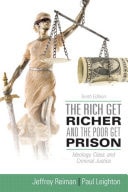
The Rich Get Richer and the Poor Get Prison
0
0
As an Amazon Associate and affiliate partner, Menrva Books earns from qualifying purchases. Learn more
Author Description
Illustrates The Issue Of Economic Inequality Within The American Justice System. The Best-selling Text, The Rich Get Richer And The Poor Get Prison Contends That The Criminal Justice System Is Biased Against The Poor From Start To Finish. The Authors Argue That Even Before The Process Of Arrest, Trial, And Sentencing, The System Is Biased Against The Poor In What It Chooses To Treat As Crime. The Authors Show That Numerous Acts Of The Well-off--such As Their Refusal To Make Workplaces Safe, Refusal To Curtail Deadly Pollution, Promotion Of Unnecessary Surgery, And Prescriptions For Unnecessary Drugs--cause As Much Harm As The Acts Of The Poor That Are Treated As Crimes. However, The Dangerous Acts Of The Well-off Are Almost Never Treated As Crimes, And When They Are, They Are Almost Never Treated As Severely As The Crimes Of The Poor. Not Only Does The Criminal Justice System Fail To Protect Against The Harmful Acts Of Well-off People, It Also Fails To Remedy The Causes Of Crime, Such As Poverty. This Results In A Large Population Of Poor Criminals In Our Prisons And In Our Media. The Authors Contend That The Idea Of Crime As A Work Of The Poor Serves The Interests Of The Rich And Powerful While Conveying A Misleading Notion That The Real Threat To Americans Comes From The Bottom Of Society Rather Than The Top. Learning Goals Upon Completing This Book, Readers Will Be Able To: Examine The Criminal Justice System Through The Lens Of The Poor. Understand That Much Of What Goes On In The Criminal Justice System Violates One’s Own Sense Of Fairness. Morally Evaluate The Criminal Justice System’s Failures. Identify The Type Of Legislature That Is Biased Against The Poor.
Menrva's Summary
THE THESIS
This text investigates the systemic bias within the American criminal justice system, arguing that it functions to protect the interests of the wealthy while disproportionately penalizing the poor. The authors, Jeffrey Reiman and Paul Leighton, utilize extensive sociological data and legal analysis to demonstrate that the definition of 'crime' is socially constructed to ignore harmful acts committed by the elite—such as corporate negligence and environmental pollution—while focusing enforcement efforts on street-level offenses. By examining the structural failures of the legal apparatus, the book posits that the current system serves to maintain existing power hierarchies rather than ensuring public safety or justice.
THE SCOPE MAP
What You Will Find
- Analysis of corporate and white-collar crimes versus traditional street crimes.
- Examination of the legislative and judicial processes that favor the wealthy.
- Discussion of the socioeconomic roots of crime and the failure of the state to address poverty.
- Evaluation of how media representation shapes public perception of criminal threats.
THE AUTHORITY PERSPECTIVE
This work is widely regarded as a foundational text in critical criminology, frequently utilized in academic settings to challenge conventional understandings of law and order. Its systematic approach to exposing institutional inequality provides a rigorous framework for students and scholars to evaluate the moral and practical failures of the American penal system.
Page Count:
272
Publication Date:
2012-01-01
Publisher:
Pearson Higher Ed
ISBN-10:
0205924492
ISBN-13:
9780205924493
Law
Social justice
Sociology
Criminology
Community Tags
Similar Books