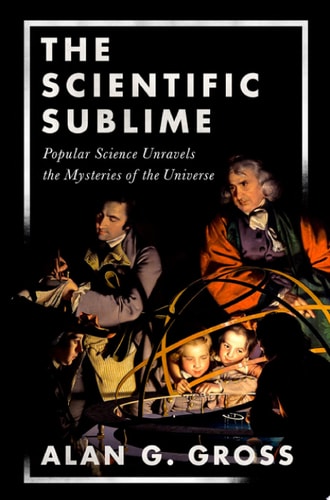
The Scientific Sublime: Popular Science Unravels the Mysteries of the Universe
0
0
As an Amazon Associate and affiliate partner, Menrva Books earns from qualifying purchases. Learn more
Author Description
The sublime evokes our awe, our terror, and our wonder. Applied first in ancient Greece to the heights of literary expression, in the 18th-century the sublime was extended to nature and to the sciences, enterprises that viewed the natural world as a manifestation of God's goodness, power, and wisdom. In The Scientific Sublime, Alan Gross reveals the modern-day sublime in popular science. He shows how the great popular scientists of our time--Richard Feynman, Stephen Hawking, Steven Weinberg, Brian Greene, Lisa Randall, Rachel Carson, Stephen Jay Gould, Steven Pinker, Richard Dawkins, and E. O. Wilson--evoke the sublime in response to fundamental questions: How did the universe begin? How did life? How did language? These authors maintain a tradition initiated by Joseph Addison, Edmund Burke, Immanuel Kant, and Adam Smith, towering 18th-century figures who adapted the literary sublime first to nature, then to science--though with one crucial difference: religion has been replaced wholly by science. In a final chapter, Gross explores science's attack on religion, an assault that attempts to sweep permanently under the rug two questions science cannot answer: What is the meaning of life? What is the meaning of the good life?
Menrva's Summary
THE THESIS
This book investigates how contemporary popular science writing functions as a modern iteration of the aesthetic concept of the sublime, replacing religious wonder with scientific inquiry. Alan G. Gross, a professor emeritus of communication, utilizes a rhetorical framework to analyze how prominent scientists communicate complex theories to the public. He argues that these authors maintain a historical tradition of the sublime, shifting the focus from divine manifestation to the awe-inspiring scale and complexity of the natural world.
THE SCOPE MAP
What You Will Find
- A rhetorical analysis of works by Richard Feynman, Stephen Hawking, Steven Weinberg, Brian Greene, Lisa Randall, Rachel Carson, Stephen Jay Gould, Steven Pinker, Richard Dawkins, and E. O. Wilson.
- A historical overview of the sublime from ancient Greece through 18th-century thinkers like Edmund Burke and Immanuel Kant.
- An examination of the tension between scientific explanation and the philosophical questions of meaning and morality.
Scope Limits
- The text does not provide a comprehensive history of all popular science writing, focusing instead on those who evoke the sublime.
- It does not offer a theological defense of religion, but rather analyzes the rhetorical shift from religious to scientific awe.
THE AUTHORITY PERSPECTIVE
Scholars in the fields of rhetoric and science communication note the book's effectiveness in bridging literary theory with scientific discourse. Readers frequently highlight the author's ability to synthesize complex philosophical history with accessible analysis of modern scientific literature.
Page Count:
328
Publication Date:
2018-01-01
Publisher:
Oxford University Press
ISBN-10:
019063779X
ISBN-13:
9780190637798
History
Philosophy
Science
Popular Science
Literary Criticism
Science History
Science
Earth Sciences
Community Tags
Similar Books