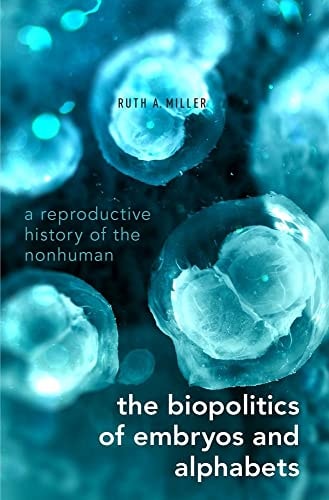
The Biopolitics of Embryos and Alphabets: A Reproductive History of the Nonhuman
0
0
As an Amazon Associate and affiliate partner, Menrva Books earns from qualifying purchases. Learn more
Author Description
Biopolitics and posthumanism have been passé theories in the academy for a while now, standing on the unfashionable side of the fault line between biology and liberal thought. These days, if people invoke them, they do so a bit apologetically. But, as Ruth Miller argues, we should not be so quick to relegate these terms to the scholarly dustbin. This is because they can help to explain an increasingly important (and contested) influence in modern democratic politics-that of nostalgia. Nostalgia is another somewhat embarrassing concept for the academy. It is that wistful sense of longing for an imaginary and unitary past that leads to an impossible future. And, moreover for this book, it is ordinarily considered "bad" for democracy. But, again, Miller says, not so fast. As she argues in this book, nostalgia is the mode of engagement with the world that allows thought and life to coexist, productively, within democratic politics.Miller demonstrates her theory by looking at nostalgia as a nonhuman mode of "thought" embedded in biopolitical reproduction. To put this another way, she looks at mass democracy as a classically nonhuman affair and nostalgic, nonhuman reproduction as the political activity that makes this democracy happen. To illustrate, Miller draws on the politics surrounding embryos and the modernization of the Turkish alphabet. Situating this argument in feminist theories of biopolitics, this unusual and erudite book demonstrates that nostalgia is not as detrimental to democratic engagement as scholars have claimed.
Menrva's Summary
THE THESIS
This book investigates whether nostalgia, often dismissed as an impediment to democratic function, actually serves as a necessary mode of engagement that allows thought and life to coexist within modern democratic politics. Ruth A. Miller, a scholar of political theory, challenges the academic tendency to relegate biopolitics and posthumanism to the periphery of liberal thought. By synthesizing feminist theory with an analysis of nonhuman reproduction, she argues that nostalgia functions as a productive political activity that sustains mass democracy rather than undermining it.
THE SCOPE MAP
What You Will Find
- A theoretical framework linking biopolitics, posthumanism, and democratic nostalgia
- An analysis of the modernization of the Turkish alphabet as a case study in nonhuman reproduction
- An examination of the political discourse surrounding embryos
- A critique of traditional liberal views on the role of nostalgia in democratic governance
Scope Limits
- The text does not provide a comprehensive history of Turkish linguistic reform beyond its relevance to the author's biopolitical thesis
- The work does not offer a general guide to reproductive technology or policy
THE AUTHORITY PERSPECTIVE
Scholars in political theory and posthumanist studies identify this work as a dense, erudite intervention that reclaims marginalized concepts for contemporary democratic analysis. Readers frequently note the high level of theoretical complexity, marking it as a specialized text for those already familiar with biopolitical discourse.
Page Count:
200
Publication Date:
2017-09-01
Publisher:
Oxford University Press
ISBN-10:
0190638354
ISBN-13:
9780190638351
Philosophy
Biopolitics
Posthumanism
Bioethics
Cultural History
Sociobiology
Feminist Theory