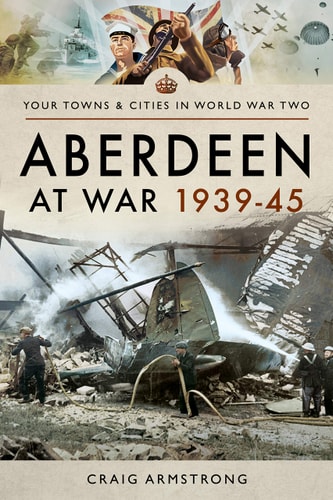
Aberdeen at War 1939-45
0
0
As an Amazon Associate and affiliate partner, Menrva Books earns from qualifying purchases. Learn more
Author Description
Scotland was of grave strategic importance during the war due to its geographical position, while its capital was the location of a significant number of important military and civil organizations. Aberdeen possessed important shipbuilding facilities, including Hall, Russell & Co., which built a number of vessels during the war, such as corvettes and frigates, resulting in the yard being targeted by the Luftwaffe on a number of occasions. The fishing fleet was also of prime importance in supplying food for a war-starved Britain and many Aberdeenshire men constantly risked their lives putting out to sea in order to land fish. Many were killed in attacks by enemy aircraft or mines. No member of the population of Aberdeen escaped the war, whether it was the huge numbers of men and women from the area who came forward for service in the military or in roles such as the Home Guard, ARP services, nursing, working in vital war industries, or struggling to maintain a household under strict rationing and the stresses of wartime life. Evacuation proved a thorny issue as Aberdeen was originally classed as a 'neutral area' and no plans were made for evacuation. By 1940, however, there was anger and frustration as several groups petitioned for this classification to be changed. These petitioners were probably proved correct as Aberdeen went on to become the most frequently raided city (after London) in Britain suffering 32 attacks and 364 air raid warnings earning the city the nickname the 'Siren City'. Aberdeen also suffered the final Luftwaffe attack on Scottish soil when a concerted attack was made on 21 April 1943, resulting in 125 deaths and an estimated 12,000 houses being either destroyed or damaged. Aberdeenshire also played a significant role in the war effort in the air. It was ideally placed to enable the RAF to patrol not only the northeast of Scotland, but also the North Sea and the vital approaches to the naval base at Orkney, while the
Menrva's Summary
THE THESIS
of this book is that Aberdeen and Aberdeenshire played a crucial, multifaceted role in the British war effort during World War II, extending far beyond its strategic geographical position.** The book details the vital contributions of the city's shipbuilding facilities, the perilous but essential work of its fishing fleet, and the widespread involvement of its population in military service and civilian defense roles. It examines the challenges faced by the city, including the controversial issue of evacuation and the significant impact of frequent air raids, which earned it the moniker 'Siren City'. The narrative also highlights Aberdeenshire's importance in air defense and its role in patrolling crucial North Sea routes.
THE SCOPE MAP
- Detailed accounts of Aberdeen's shipbuilding industry, including Hall, Russell & Co., and the types of vessels constructed.
- An exploration of the critical role of the Aberdeenshire fishing fleet in supplying Britain during wartime.
- Analysis of the civilian population's involvement in military service, Home Guard, ARP, nursing, and war industries.
- Discussion of the evacuation policies and the public's reaction to Aberdeen's classification as a 'neutral area'.
- Chronicles of the air raids on Aberdeen, its nickname 'Siren City', and the devastating final Luftwaffe attack.
- The strategic importance of Aberdeenshire in RAF air patrols over Scotland and the North Sea.
THE AUTHORITY PERSPECTIVE
The book appears to be a detailed historical account focusing on the specific experiences of Aberdeen and Aberdeenshire during World War II. Its scope suggests a deep dive into local contributions, civilian life under wartime conditions, and the impact of military actions on the region. The emphasis on specific industries like shipbuilding and fishing, alongside the detailed recounting of air raids, indicates a work aimed at providing a comprehensive understanding of the war's localized effects. This approach likely appeals to readers interested in regional history and the human impact of major global conflicts.
Page Count:
128
Publication Date:
2020-01-01
Publisher:
Pen & Sword Books Limited
ISBN-10:
1473899168
ISBN-13:
9781473899162
History
Non-Fiction
Scottish History
Community Tags
Similar Books