
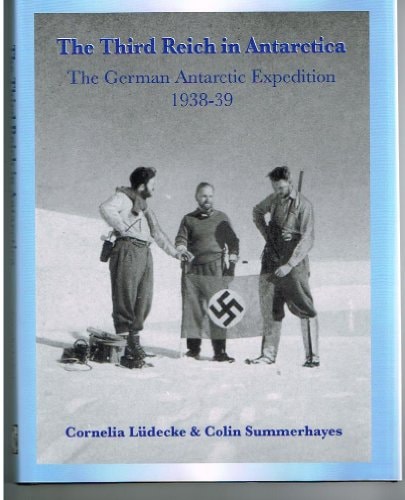
The Third Reich in Antarctica: The German Antarctic Expedition, 1938-39
0
0
As an Amazon Associate and affiliate partner, Menrva Books earns from qualifying purchases. Learn more
Author Description
The origins of the Third German Antarctic Expedition lie in a unique combination of the aspirations of German scientists to contribute to exploring and understanding the Antarctic environment, and the Nazi Parti's drive for self-sufficiency on the road to war. Germany had joined the whaling nations in the South Atlantic, keen to obtain whale oil without having to use valuable foreign currency reserves needed for rearmament. It decided to explore the possibility of setting up a supply base on the coast of Dronning Maud Land and to claim Antarctic territory there for itself. Councillor of State Helmut Wohlthat, the man in charge of German whaling, put this idea to his superior, Hermann Goring, the Commissioner for the Four Year Plan for economic development who approved the concept, and in May 1938 assigned resources for a reconnaissance expedition.Thus the Third German Antarctic Expedition was born. When they set sail they did not even have a map of where they were going and it was their job to make one. The expedition was led by Alfred Ritscher, a captain in the German merchant navy, aboard the MS Schwabenland, a freighter built in 1925 and renamed after the Swabia region in Southern Germany. On January 19, 1939, it arrived off Dronning Maud Land and began charting the region. Nazi German flags were placed on the sea ice along the coast and the area was named Neuschwabenland after the ship. Seven photographic survey flights were made by the ship's two seaplanes which took more than 16,000 aerial photographs covering an area of some 250,000 square kilometres. On its return trip to Germany the expedition made oceanographic studies near Bouvet Island and Fernando de Noronha. This is the story of an ambitious and little-known expedition, which set out to map a large piece of Antarctica from the air, and in the process discovered an 800 km long mountain range and previously unsuspected freshwater lakes.
Menrva's Summary
THE THESIS
This book investigates the motivations and outcomes of the Third German Antarctic Expedition of 1938-39, examining the complex interplay between scientific exploration and Nazi political objectives. It details how the expedition, driven by both scientific curiosity and the Nazi Party's desire for self-sufficiency and territorial claims, set sail with the primary goal of mapping Dronning Maud Land and establishing a potential supply base. The narrative follows Captain Alfred Ritscher and his crew aboard the MS Schwabenland as they undertake photographic surveys, chart unknown territories, and make significant geographical discoveries, all while operating under the shadow of rearmament and the looming war.
THE SCOPE MAP
- The origins and political context of the Third German Antarctic Expedition.
- The scientific aspirations of German explorers and the Nazi Party's drive for self-sufficiency.
- Details of the expedition's leadership, ship, and operational timeline.
- The process of charting Dronning Maud Land and the naming of Neuschwabenland.
- The use of aerial photography and its scale (over 16,000 photographs covering 250,000 sq km).
- Key discoveries, including an 800 km mountain range and freshwater lakes.
- Oceanographic studies conducted during the return journey.
THE AUTHORITY PERSPECTIVE
This work meticulously details a lesser-known historical expedition, highlighting the blend of scientific endeavor and political ambition during the Third Reich's expansionist period. It draws upon the expedition's own records and objectives to present a comprehensive account of its activities and findings in Antarctica. The book serves as a valuable resource for understanding the geopolitical undercurrents of polar exploration in the late 1930s.
Page Count:
286
Publication Date:
2012-12-15
Publisher:
CreateSpace Independent Publishing Platform
ISBN-10:
1720918899
ISBN-13:
9781720918899
History
Non-Fiction
Antarctica
Exploration
Community Tags
Similar Books








Reader Comments
Share Your Thoughts
No comments yet. Be the first to share your thoughts!