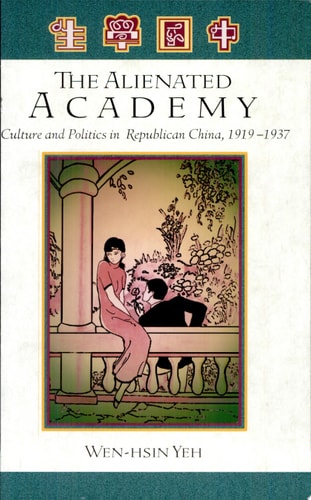
The Alienated Academy: Culture and Politics in Republican China, 1919-1937
0
0
As an Amazon Associate and affiliate partner, Menrva Books earns from qualifying purchases. Learn more
Author Description
The enormous changes in twentieth-century Chinese higher education up to the Sino-Japanese War are detailed in this pioneering work. Yeh examines the impact of instruction in English and of the introduction of science and engineering into the curriculum. Such innovations spurred the movement of higher education away from the gentry academies focused on classical studies and propelled it toward modern middle-class colleges with diverse programs. Yeh provides a typology of Chinese institutions of higher learning in the Republican period and detailed studies of representative universities. She also describes student life and prominent academic personalities in various seats of higher learning. Social changes and the political ferment outside the academy affected students and faculty alike, giving rise, as Yeh contends, to a sense of alienation on the eve of war.
Menrva's Summary
THE THESIS
This book investigates the profound transformations and inherent tensions within Chinese higher education during the pivotal Republican era, from 1919 to 1937. Wen-hsin Yeh meticulously details the seismic shifts in Chinese higher education, moving from traditional gentry academies to modern, middle-class colleges. The work scrutinizes the influence of English instruction and the integration of science and engineering, which fundamentally altered academic programs. Yeh offers a classification of institutions and in-depth case studies of key universities, alongside vivid portrayals of student life and influential academic figures. The narrative also explores how external social changes and political unrest impacted both students and faculty, fostering a pervasive sense of alienation on the cusp of war.
THE SCOPE MAP
- Analysis of the impact of English instruction on the curriculum.
- Examination of the introduction of science and engineering into higher education.
- Typology of Chinese institutions of higher learning during the Republican period.
- Detailed case studies of representative universities.
- Descriptions of student life and prominent academic personalities.
- Exploration of the influence of social changes and political ferment on academia.
- Argument for the rise of a sense of alienation among students and faculty.
THE AUTHORITY PERSPECTIVE
Wen-hsin Yeh's "The Alienated Academy" is recognized as a pioneering work that comprehensively details the significant changes in twentieth-century Chinese higher education leading up to the Sino-Japanese War. The book is lauded for its thorough examination of curriculum shifts, institutional typologies, and the social and political forces that shaped academic life. Scholars have noted its insightful analysis of the move from classical studies to modern scientific and engineering disciplines, and its exploration of the resulting sense of alienation among students and faculty. The work is considered essential for understanding the complex evolution of Chinese academia during a period of immense national transformation.
Page Count:
449
Publication Date:
2000-01-01
Publisher:
Harvard Univ Asia Center
ISBN-10:
0674002849
ISBN-13:
9780674002845
Non-Fiction
Politics
History
Education
Social History
Community Tags
Similar Books