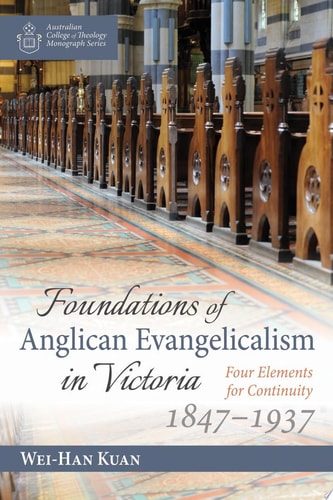
Foundations of Anglican Evangelicalism in Victoria Four Elements for Continuity, 1847-1937
0
0
As an Amazon Associate and affiliate partner, Menrva Books earns from qualifying purchases. Learn more
Author Description
For more than half a century, the Anglican Diocese of Melbourne was unquestionably the most rigorously evangelical and missions-oriented diocese in Australia. The Diocese of Sydney, in that same period, was decidedly broader in theological and liturgical practice. How and why did Melbourne move in one direction, while Sydney in the other? This study suggests that the answers are to be found in four vital contributors: local churches, evangelical societies, theological colleges, and diocesan bishops. For three broad periods of history between 1847 and 1937, the presence of these four contributors is uncovered, described, and evaluated for the Diocese of Melbourne. Evangelical activism, theological reflection, and leadership are each shown in their contemporary contexts to help us understand how people with gospel passion sought to respond faithfully to their times. This is the question of vision, leadership, and strategy at the heart of this study: “What makes for long-term evangelical continuity over a hundred-year period?”
Menrva's Summary
THE THESIS
This study investigates the enduring continuity of Anglican Evangelicalism in the Diocese of Melbourne between 1847 and 1937, contrasting it with the broader theological practices of the Diocese of Sydney. The author posits that four key elements—local churches, evangelical societies, theological colleges, and diocesan bishops—were instrumental in shaping Melbourne's distinct evangelical trajectory. By examining these contributors across three historical periods, the book details how evangelical activism, theological reflection, and leadership functioned within their contemporary contexts. The central question driving this research is what factors enable long-term evangelical continuity over a century.
THE SCOPE MAP
- Analysis of the role of local churches in fostering evangelical continuity.
- Examination of the impact of evangelical societies on diocesan direction.
- Evaluation of the contribution of theological colleges to evangelical thought and practice.
- Assessment of the influence of diocesan bishops on maintaining evangelical identity.
- Comparative study of the Diocese of Melbourne and the Diocese of Sydney.
- Historical periods covered: 1847-1937.
THE AUTHORITY PERSPECTIVE
The book offers a focused historical analysis of Anglican Evangelicalism in colonial and interwar Australia. Its detailed examination of the Diocese of Melbourne's distinctiveness suggests a scholarly approach to understanding religious and social history. The work appears to be aimed at an academic audience interested in church history, leadership studies, and Australian social development. The structured approach, identifying four key contributors, provides a clear framework for understanding long-term institutional continuity.
Page Count:
302
Publication Date:
2019-05-20
Publisher:
Wipf and Stock Publishers
ISBN-10:
1532682166
ISBN-13:
9781532682162
Non-Fiction
Religion
History
Christianity
Australian History
Anglicanism
Evangelicalism
Theology
Community Tags
Similar Books