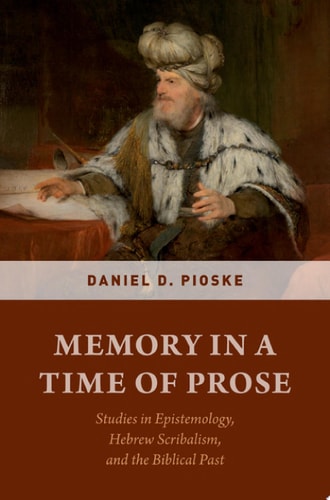
Memory in a Time of Prose
0
0
As an Amazon Associate and affiliate partner, Menrva Books earns from qualifying purchases. Learn more
Author Description
Memory In A Time Of Prose Investigates A Deceptively Straightforward Question: What Did The Biblical Scribes Know About Times Previous To Their Own? Daniel D. Pioske Attempts To Answer This Question By Studying The Sources, Limits, And Conditions Of Knowing That Would Have Shaped Biblical Stories Told About A Past That Preceded The Composition Of These Writings By A Generation Or More. This Book Is Comprised Of A Series Of Case Studies That Compare Biblical References To An Early Iron Age World (ca. 1175-830 Bce) With A Wide Range Of Archaeological And Historical Evidence From The Era In Which These Stories Are Set. Pioske Examines The Relationship Between The Past Disclosed Through These Historical Traces And The Past Represented Within The Biblical Narrative. He Discovers That The Knowledge Available To The Biblical Scribes About This Period Derived Predominantly From Memory And Word Of Mouth, Rather Than From A Corpus Of Older Narrative Documents. For Those Hebrew Scribes Who First Set Down These Stories In Prose Writing, The Means For Knowing A Past And The Significance Attached To It Were, In Short, Wed Foremost To The Faculty Of Remembrance. Memory In A Time Of Prose Reveals How The Past Was Preserved, Transformed, Or Forgotten In The Ancient World Of Oral, Living Speech That Informed Biblical Storytelling.
Menrva's Summary
THE THESIS
This book investigates how biblical scribes accessed and represented historical periods that preceded their own writing by several generations. Daniel D. Pioske, a scholar of the ancient Near East, utilizes a comparative framework to analyze the intersection of archaeological data and biblical narrative. He argues that the primary mechanism for preserving historical knowledge during the early Iron Age was oral tradition and collective memory rather than written archival records.
THE SCOPE MAP
What You Will Find
- Comparative analysis of Early Iron Age archaeological evidence (ca. 1175-830 BCE) against biblical prose accounts.
- Methodological exploration of how oral cultures encode and transmit historical information.
- Case studies focusing on specific biblical narratives and their historical counterparts.
Scope Limits
- The study does not provide a comprehensive history of the entire Iron Age period.
- It does not attempt to verify the factual accuracy of every biblical event described.
THE AUTHORITY PERSPECTIVE
Scholars in the field of biblical studies recognize this work as a significant contribution to the understanding of ancient historiography and oral tradition. Readers frequently note the academic density of the prose, which is best suited for those with a background in historical-critical methods.
Page Count:
320
Publication Date:
2018-01-01
Publisher:
Oxford University Press
ISBN-10:
0190649860
ISBN-13:
9780190649869
History
Oral Tradition
Historiography
Near East
Archaeology
Community Tags
Similar Books