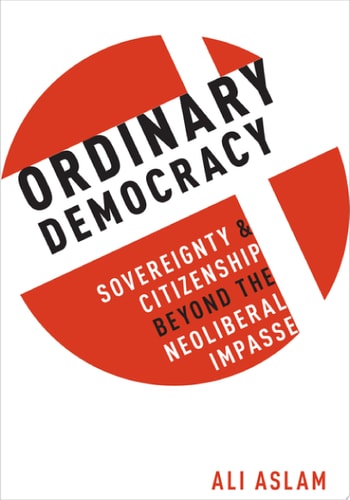
Ordinary Democracy: Sovereignty and Citizenship Beyond the Neoliberal Impasse
0
0
As an Amazon Associate and affiliate partner, Menrva Books earns from qualifying purchases. Learn more
Author Description
While various democratic theorists have looked at particular instances of recent social movements (Occupy or the Arab Spring, for example), none have yet attempted a more general theoretical take on what it is that relates all of these movements and what that running thread can tell us about democratic theory. Ordinary Democracy argues that there is a commonality to these movements as well as a striking lesson about the nature of democracy, sovereignty, agency and solidarity today: in that these movements all highlight the ordinariness of neoliberal regimes and the ways in which citizens find solidarity and a sense of freedom in the marketplace. Ali Aslam contends that neoliberalism is more than a set of policies, ideological principles, or a distinct phase of capitalism-rather it constitutes the ways in which citizens think about their everyday lives. Conceived as common sense, it also governs what is permitted or forbidden in public discourse (for example, rendering issues of private debt a personal responsibility). Mass movements call attention to the effects of neoliberalism, providing a way to contest its acceptability; in doing so they help to contextualize the impasse that marks a language of civil empowerment and inclusion on one hand, and feelings of powerlessness, diminished agency and impassivity on the other. In Aslam's view, democratic theorists who view participatory agency as offering the most authentic opportunity to satisfy the need for solidarity and freedom minimize the degree to which capitalism satisfies most citizens, as well as the depth of most people's affective attachment to neoliberalism. Looking in particular at Idle No More, Occupy Wall Street, Occupy Sandy, the Egyptian Revolution, and Strike Debt, Aslam takes what may be a more sobering, but still hopeful, view toward the potential of mass movements: to resist the normalization of conceptions of solidarity and citizenship under neoliberalism.
Menrva's Summary
THE THESIS
This work investigates the core question of how contemporary mass movements challenge the normalization of neoliberalism as a common-sense framework for citizenship and sovereignty. Ali Aslam, a scholar of political theory, examines the intersection of democratic agency and the affective attachments citizens hold toward neoliberal structures. By analyzing the limitations of traditional democratic theory, the author argues that neoliberalism functions as an internalized logic that governs public discourse and personal responsibility, necessitating a reevaluation of how resistance movements operate within this impasse.
THE SCOPE MAP
What You Will Find
- Theoretical analysis of neoliberalism as a pervasive social and political logic
- Critical evaluation of participatory agency in modern democratic theory
- Comparative study of diverse global and local social movements
- Examination of the tension between civil empowerment and systemic powerlessness
Scope Limits
- The text does not provide a prescriptive manual for organizing future social movements
- It does not offer an exhaustive history of the specific movements mentioned, focusing instead on their theoretical implications
THE AUTHORITY PERSPECTIVE
Scholars and political theorists frequently note the analytical rigor with which Aslam deconstructs the affective dimensions of neoliberalism. The text is recognized as a significant contribution to contemporary democratic theory for its sobering assessment of how capitalism shapes individual identity and political possibility.
Page Count:
224
Publication Date:
2016-01-01
Publisher:
Oxford University Press
ISBN-10:
0190648678
ISBN-13:
9780190648671
Neoliberalism
Democracy
Sociology
Political Theory
Community Tags
Similar Books