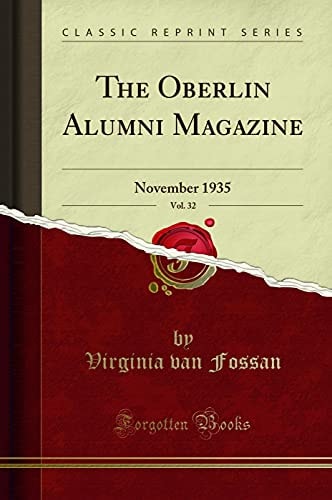
The Oberlin Alumni Magazine, Vol. 32 November 1935 (Classic Reprint)
0
0
As an Amazon Associate and affiliate partner, Menrva Books earns from qualifying purchases. Learn more
Author Description
Excerpt from The Oberlin Alumni Magazine, Vol. 32: November 1935 Further, no one has explored creative processes sufficiently to explain them in general. Who can defend with any tell ing evidence the view that a work of art springs from the class consciousness of the artist? Mrs. Teare thinks that Mil ton's stunning conception of Satan was brought forth by the active part Milton took in the Puritan Rebellion. This view in no way explains the appearance at least nine centuries earlier in the Caed monian Genesis B of that same Satan. At that time, there was no Puritan Rebel lion to bring him forth. About the Publisher Forgotten Books publishes hundreds of thousands of rare and classic books. Find more at www.forgottenbooks.com This book is a reproduction of an important historical work. Forgotten Books uses state-of-the-art technology to digitally reconstruct the work, preserving the original format whilst repairing imperfections present in the aged copy. In rare cases, an imperfection in the original, such as a blemish or missing page, may be replicated in our edition. We do, however, repair the vast majority of imperfections successfully; any imperfections that remain are intentionally left to preserve the state of such historical works.
Menrva's Summary
THE THESIS
This article excerpt from The Oberlin Alumni Magazine questions the prevailing theories on the origins of artistic creation, specifically challenging the notion that art stems solely from an artist's socio-political context. It examines the example of Milton's Satan, noting its striking similarity to a Satanic figure appearing centuries earlier in the Caedmonian Genesis B, suggesting that artistic archetypes may transcend specific historical or class-based influences. The author implies that the creative process is more complex and less understood than current theories allow, hinting at deeper, perhaps universal, sources for artistic conception.
THE SCOPE MAP
- Analysis of artistic creation theories
- Exploration of the origins of the concept of Satan in art
- Comparison of Milton's conception of Satan with earlier depictions
- Discussion of the influence of historical context on art
- Critique of class consciousness as the sole driver of artistic output
- Examination of the Caedmonian Genesis B
THE AUTHORITY PERSPECTIVE
This excerpt, presented as a classic reprint, engages with art historical and literary criticism by questioning established theories on artistic inspiration. The text directly addresses the reader by posing rhetorical questions and presenting comparative examples, inviting contemplation on the nature of creativity. The publisher's note indicates a focus on preserving historical texts, suggesting the content is valued for its historical perspective rather than for contemporary relevance or critical acclaim. The material implies a scholarly or academic audience interested in the history of art and literary theory.
Page Count:
34
Publication Date:
2017-11-09
Publisher:
FB&C Limited
ISBN-10:
0265009049
ISBN-13:
9780265009048
History
Non-Fiction
Periodicals
Community Tags
Similar Books