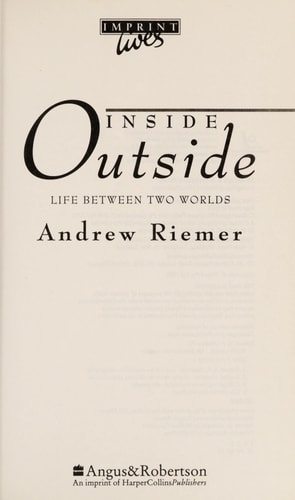
Inside Outside: Life Between Two Worlds
0
0
As an Amazon Associate and affiliate partner, Menrva Books earns from qualifying purchases. Learn more
Author Description
Autobiographical account of the changes observed in Australian society in the years following World War II as experienced by the author and his family after leaving Hungary. The author's return to Budapest in 1990 prompts comparisons to the situation in Australia. From Publishers Weekly A Sydney-based academic and critic, Riemer here recalls the circumstances of his family history. Born in Budapest in 1936, he emigrated with his parents to Australia in 1947. Although he alludes in general terms to the turmoil in Europe in the '40s, the subject of this book is not why he left Hungary but rather what he found in Australia. The family's unreal expectations of a tropical paradise where they would continue to lead their comfortable lifestyle were rudely shattered. His father, a prosperous manufacturer of fine fabrics in Hungary, found no market for his goods in Australia. And suburban Sydney, where they settled, was a dreary cultural desert. In school the language barrier put Riemer into a class for intellectually handicapped children, and, though he would later join normal children, he continued to feel isolated by his physical appearance (short, dark) from his tall, fair classmates. In 1990, as a graduate student of English literature, Riemer returned to Budapest, a defining visit as he came to grips with the reality of a decaying city, just emerging from totalitarian rule and bearing little resemblance to his nostalgic memories. Throughout this thoughtful memoir, the author muses on the immigrant's paradox: whether to seek elusive assimilation, or to maintain one's ethnicity and risk a "ghetto mentality." Neither route offers a solution for him. He remains, he says, essentially rootless. Copyright 1994 Reed Business Information, Inc.
Menrva's Summary
THE THESIS
How does the immigrant experience shape personal identity when caught between the memory of a lost homeland and the reality of an alien new society? A. P. Riemer, a Sydney-based academic and critic, utilizes his own family history to examine the psychological and social friction of post-World War II migration. By contrasting his childhood arrival in Australia with a return to Budapest in 1990, he constructs a framework for understanding the inherent rootlessness of the displaced individual.
THE SCOPE MAP
What You Will Find
- Analysis of the post-war immigrant experience in suburban Sydney.
- Comparative study of 1940s Hungarian cultural expectations versus Australian reality.
- Reflections on the tension between assimilation and the maintenance of ethnic identity.
- Observations on the decay of post-totalitarian urban environments in Eastern Europe.
THE AUTHORITY PERSPECTIVE
The text offers a measured, academic reflection on the immigrant condition, prioritizing sociological observation over purely emotional narrative. Its focus on the paradox of belonging provides a clear, intellectualized perspective on the long-term effects of displacement.
Page Count:
218
Publication Date:
1994-01-01
Publisher:
Harpercollins
ISBN-10:
0207173982
ISBN-13:
9780207173981
Biography
Memoir
Immigration
Australian History
Community Tags
Similar Books