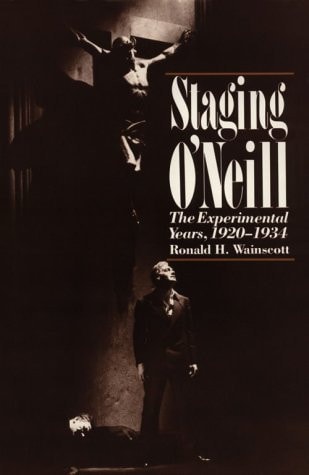
Staging O'Neill: The Experimental Years, 1920-1934
0
0
As an Amazon Associate and affiliate partner, Menrva Books earns from qualifying purchases. Learn more
Author Description
Eugene O'Neill's most exciting experiments with stage direction and design took place in his plays produced between 1920 and 1934. The impact of these experiments on American theater and drama was enormous, and in this book Ronald H. Wainscott critically examines the staging of these innovative works. Beginning with the first professional production of a new O'Neill play, Beyond the Horizon, and concluding with Days Without End, Wainscott recreates the initial performances of twenty-two works, including The Emperor Jones, Anna Christie, The Hairy Ape, and Mourning Becomes Electra. Using a wide range of unpublished material including prompt books, ground plans, design elevations, publicity materials, letters, and manuscript notes, Wainscott provides fascinating details about the production of these plays. He discusses their preproduction histories; how the actors, designers, directors, and theaters were selected; the design of plays, including set, costumes, lighting, music, and sound; the director's work; the acting; and the critical response. He analyzes how the various artists approached stage composition and use of the performance space, as well as techniques and devices such as masks, sound effects, music, simultaneous settings, internal monologues, and split characterizations. Revealing a great deal about O'Neill's relationships with directors--most notably Robert Edmond Jones and Philip Moeller--Wainscott demonstrates that the era was a maturation period not only for American playwriting but also for American directing and design. "A wonderful book, the best of the recent studies of O'Neill and a remarkable work of theater history. What Wainscott has to tell is important not only to those generally interested in O'Neill and in theater history, but to actors, designers, and directors as well." -Travis Bogard, University of California, Berkeley
Menrva's Summary
THE THESIS
This book critically examines the staging and production of Eugene O'Neill's plays between 1920 and 1934, a period of significant experimental innovation in American theater. Ronald H. Wainscott, drawing on extensive unpublished materials such as prompt books, ground plans, and letters, meticulously reconstructs the initial performances of twenty-two of O'Neill's works. He analyzes the collaborative efforts of actors, designers, and directors, detailing aspects of set design, costumes, lighting, music, sound, and the directorial and acting processes. The book demonstrates how these productions not only matured O'Neill's playwriting but also advanced the fields of American directing and design.
THE SCOPE MAP
- Detailed recreations of the initial performances of twenty-two plays by Eugene O'Neill, including major works like 'The Emperor Jones', 'Anna Christie', 'The Hairy Ape', and 'Mourning Becomes Electra'.
- Examination of pre-production histories, including the selection of actors, designers, and directors.
- Analysis of stage design elements: sets, costumes, lighting, music, and sound.
- Exploration of directorial approaches and acting techniques employed during the period.
- Discussion of O'Neill's relationships with key collaborators, particularly Robert Edmond Jones and Philip Moeller.
- Insights into innovative staging techniques such as masks, simultaneous settings, and split characterizations.
- Critical response to the productions and their impact on American theater.
THE AUTHORITY PERSPECTIVE
This book is regarded as a significant contribution to theater history, particularly concerning the works of Eugene O'Neill. Travis Bogard of the University of California, Berkeley, praised it as "a wonderful book, the best of the recent studies of O'Neill and a remarkable work of theater history." The detailed examination of production elements and the collaborative process makes it valuable for scholars, students, and practitioners in the field of theater.
Page Count:
337
Publication Date:
1988-01-01
Publisher:
Yale University Press
ISBN-10:
0300041527
ISBN-13:
9780300041521
History
Non-Fiction
American Theater
Theater History
Community Tags
Similar Books