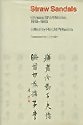
Straw Sandals: Chinese Short Stories 1918-1933
0
0
As an Amazon Associate and affiliate partner, Menrva Books earns from qualifying purchases. Learn more
Author Description
Straw Sandals is a collection of 23 stories, a play, and a poem by 16 Chinese writers selected to represent the radical literature produced in China between 1918 and 1933. It was assembled in Peking in 1934 by Harold R. Isaacs with the advice and guidance of Lu Hsün, China's foremost literary figure of this century, and Mao Tun, leading novelist of the younger group that had gathered around Lu Hsün in those tumultuous years. The first half of the collection, including several of Lu Hsün's most famous stories, typifies work that appeared in the first years of China's modern cultural renaissance—short stories written in vernacular Chinese that rejected surviving Chinese traditionalism with its philosophic and social outlooks, its rules of behavior for family life and relationships between men and women. The second group of stories represents the growing ideological and political turbulence of the 1920s and 1930s. Straw Sandals is introduced by Professor Isaacs, who describes the historical setting in which this short-lived and violence-ridden literary movement tried to make its way. He vividly presents the Shanghai of that period, where many of these writers struggled to pursue their craft and were caught between the pressures of Kuomintang repression (many were imprisoned and executed) and the demands for total conformity inside the Communist movement. His account adds an ironic perspective to the collection in light of all that has happened since that time—for the writers who survived Kuomintang repression and the war against Japan to see the Communist victory they had fought so hard and so long to bring about ultimately fell in their turn in the repeated purges that marked the Communist regime's imposition of total control over all art and literature. The English translations of a number of these stories first appeared in the China Forum, a journal that Professor Isaacs edited and published in Shanghai from 1932 to 1934. They were made by
Menrva's Summary
THE PULSE
A literary movement, born from revolution and suppressed by political upheaval, struggles to find its voice and impact in early 20th century China. The collection showcases 23 short stories, a play, and a poem by 16 Chinese writers, representing the radical literature produced between 1918 and 1933. Assembled by Harold R. Isaacs with guidance from literary giants Lu Hsün and Mao Tun, these works reflect China's modern cultural renaissance, rejecting traditionalism in favor of vernacular language and new social outlooks. The latter half of the collection captures the escalating ideological and political turbulence of the era, with writers navigating the dangerous space between Kuomintang repression and Communist Party conformity.
INSIDE THE PAGES
- Features works by 16 prominent Chinese writers from the period 1918-1933.
- Includes 23 short stories, one play, and one poem.
- Represents the radical literary output of China's modern cultural renaissance.
- Showcases stories written in vernacular Chinese that challenged traditional norms.
- Highlights the growing ideological and political tensions of the 1920s and 1930s.
- Includes some of Lu Hsün's most famous stories.
- Provides context on the writers' struggles with political repression and conformity.
- Translations of several stories first appeared in the journal 'China Forum'.
THE COLLECTIVE ECHO
This collection is presented as a vital historical document, capturing a specific, tumultuous period of Chinese literary and political history. The editor's introduction provides crucial context, detailing the challenges faced by writers caught between state repression and ideological demands. The works themselves are framed as a testament to a short-lived but significant literary movement that sought to redefine Chinese culture. The historical perspective offered by the collection, particularly in light of subsequent political developments, adds a layer of poignant reflection on the fate of these artists and their ideals.
Page Count:
444
Publication Date:
1974-06-15
Publisher:
The MIT Press
ISBN-10:
0262090147
ISBN-13:
9780262090148
Fiction
Historical Fiction
Literary Fiction
Short Stories
Asian
Chinese
Anthology
Community Tags
Similar Books