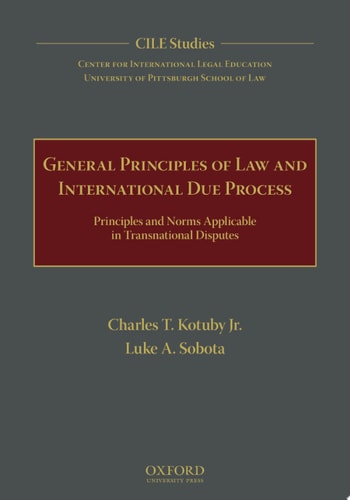
General Principles of Law and International Due Process: Principles and Norms Applicable in Transnational Disputes
0
0
As an Amazon Associate and affiliate partner, Menrva Books earns from qualifying purchases. Learn more
Author Description
Article 38 of the Statute of the International Court of Justice defines "international law" to include not only "custom" and "convention" between States but also "the general principles of law recognized by civilized nations" within their municipal legal systems. In 1953, Bin Cheng wrote his seminal book on general principles, identifying core legal principles common to various domestic legal systems across the globe. This monograph summarizes and analyzes the general principles of law and norms of international due process, with a particular focus on developments since Cheng's writing. The aim is to collect and distill these principles and norms in a single volume as a practical resource for international law jurists, advocates, and scholars. The information contained in this book holds considerable importance given the growth of inter-state intercourse resulting in the increased use of general principles over the past 60 years.General principles can serve as rules of decision, whether in interpreting a treaty or contract, determining causation, or ascertaining unjust enrichment. They also include a core set of procedural requirements that should be followed in any adjudicative system, such as the right to impartiality and the prohibition on fraud. Although the general principles are, by definition, basic and even rudimentary, they hold vital importance for the rule of law in international relations. They are meant not to define a rule of law, but rather the rule of law.
Menrva's Summary
THE THESIS
This volume investigates the application and evolution of general principles of law and international due process as foundational norms in contemporary transnational dispute resolution. The authors, affiliated with the Center for International Legal Education at the University of Pittsburgh School of Law, synthesize decades of legal development following Bin Cheng’s 1953 seminal work. By distilling principles common to diverse domestic legal systems, the text provides a framework for jurists and advocates to apply these norms to inter-state and private international disputes.
THE SCOPE MAP
What You Will Find
- Analysis of general principles as rules of decision for treaty and contract interpretation
- Examination of procedural requirements including impartiality and the prohibition of fraud
- Historical context of general principles recognized by international courts
- Practical application of norms regarding causation and unjust enrichment
Scope Limits
- Does not provide an exhaustive list of every municipal law variation globally
- Focuses primarily on international adjudicative systems rather than specific domestic litigation procedures
THE AUTHORITY PERSPECTIVE
Legal scholars and practitioners identify this work as a significant update to the study of general principles in the modern era. Readers frequently note the clarity with which the authors bridge the gap between historical theory and current international arbitration practice.
Page Count:
299
Publication Date:
2017-01-01
Publisher:
Oxford University Press
ISBN-10:
0190642726
ISBN-13:
9780190642723
Legal Theory
Transnational Dispute Resolution
Jurisprudence
Law
International Law
Professional Career & Trade
Community Tags
Similar Books