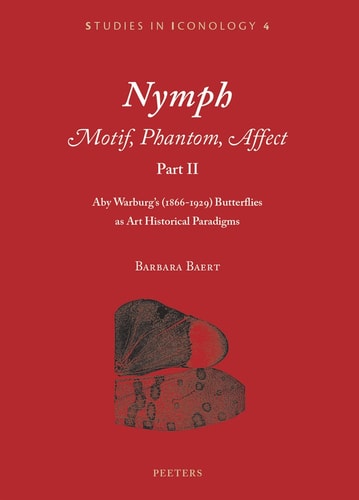
Nymph Motif, Phantom, Affect: Aby Warburg's (1866-1929) Butterflies as Art Historical Paradigms
0
0
As an Amazon Associate and affiliate partner, Menrva Books earns from qualifying purchases. Learn more
Author Description
This essay, a meditation on the butterfly and its resonance in art history, is organized in three parts. I begin with Aby Warburg's fascination with moths and butterflies as documented by (1) his letters to Andre Jolles (e.g. the letter from 1900 known as 'But such high-flown movements are not for me'), (2) the Kreuzlingen pathological report and archives by Ludwig Binswanger (1881-1966) preserved in Tubingen, and (3) the Ninfa fiorentina file in the Warburg Institute. As Seelentierchen - soul animals, psyche - butterflies are archetypically connected to deep cultural affects regarding the soul, resurrection and immortality. Part 2 of the paper considers the butterfly as paradigm for the visual medium and the oculocentric paradigms in art history. Indeed, the butterfly has a specific visual (and sensory) impact on humankind with its flashy, quick, vibrant and hypnotic wings, its medusian eyes and its capability to camouflage itself (cf. 'Sciences diagonales' by Roger Caillois (1913-1978)). Hypnosis, Medusa and camouflage are three important paradigms with which to consider the essence of the image as a dis/appearing, enchanting, and deceiving medium. In Part 3, the three paradigms become the basis for new reflections about art history (and the history of art history) as a study of the butterfly, in short, as 'lepidopterology'.
Menrva's Summary
THE THESIS
This essay investigates the butterfly as a paradigm within art history, drawing connections to Aby Warburg's work and broader cultural concepts. The author explores Warburg's fascination with butterflies and moths through his correspondence, pathological reports, and archival materials. The second part examines the butterfly's visual and sensory impact, linking its characteristics to concepts of hypnosis, Medusa, and camouflage as they relate to the nature of images. Finally, the essay proposes 'lepidopterology' as a framework for understanding art history itself.
THE SCOPE MAP
- Analysis of Aby Warburg's engagement with butterflies and moths.
- Exploration of Warburg's letters to Andre Jolles.
- Examination of the Kreuzlingen pathological report and archives by Ludwig Binswanger.
- Discussion of the Ninfa fiorentina file in the Warburg Institute.
- The butterfly as a symbol of the soul, resurrection, and immortality ('Seelentierchen').
- The butterfly as a paradigm for visual and oculocentric approaches in art history.
- Analysis of the butterfly's visual impact: flashy wings, hypnotic eyes, camouflage.
- Proposal of 'lepidopterology' as a new lens for art history.
THE AUTHORITY PERSPECTIVE
This essay offers a specialized exploration of a unique motif within art history, likely appealing to scholars and advanced students of Warburg and visual culture. The structured approach, moving from specific archival evidence to broader theoretical implications, suggests a text that is both rigorously researched and conceptually ambitious. The framing of art history through the metaphor of lepidopterology indicates a novel perspective on the discipline's methodologies and objects of study.
Page Count:
104
Publication Date:
2016-01-01
Publisher:
Peeters
ISBN-10:
904293347X
ISBN-13:
9789042933477
Non-Fiction
Art
Art History
Symbolism
Community Tags
Similar Books