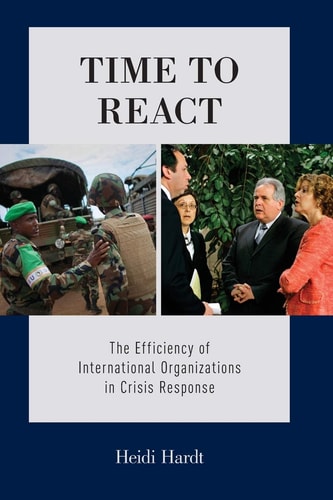
Time to React: The Efficiency of International Organizations in Crisis Response
0
0
As an Amazon Associate and affiliate partner, Menrva Books earns from qualifying purchases. Learn more
Author Description
In conflict-affected regions, delays in international response can have life or death consequences. The speed with which international organizations react to crises affects the prospects for communities to re-establish peace. Why then do some international organizations take longer than others to answer calls for intervention? To answer this question and explore options for reform, Time to React builds on contemporary scholarship with original data on response rates and interview evidence from 50 ambassadors across four leading organizations (AU, EU, OAS and OSCE). The explanation for variation in speed ultimately lies in core differences in institutional cultures across organizations. Although wealth and capabilities can strengthen a peace operation, it is the unspoken rules and social networks of peace and security committees at these organizations that dictate the pace with which an operation is established. This book offers a first analysis of the critical importance of and conditions shaping timeliness of crisis response by international organizations.
Menrva's Summary
THE THESIS
This book investigates the factors that determine the speed of crisis response within international organizations and why some entities react significantly faster than others. Heidi Hardt, an expert in international security and institutional behavior, utilizes a comparative framework to analyze the operational efficiency of major global bodies. By synthesizing original data on response rates with qualitative insights from 50 ambassadors, the author argues that institutional culture, rather than mere material wealth or military capability, serves as the primary driver of intervention speed.
THE SCOPE MAP
What You Will Find
- Comparative analysis of the African Union (AU), European Union (EU), Organization of American States (OAS), and Organization for Security and Co-operation in Europe (OSCE).
- Original quantitative data regarding crisis response timelines.
- Qualitative evidence derived from interviews with 50 high-level ambassadors.
- A framework identifying the impact of social networks and unspoken institutional rules on decision-making.
Scope Limits
- The study focuses primarily on peace and security committees rather than broader organizational administrative functions.
- The analysis does not cover non-governmental or private sector crisis response mechanisms.
THE AUTHORITY PERSPECTIVE
Experts in international relations recognize this work as a significant contribution to the study of institutional culture and its tangible effects on global security outcomes. Scholars frequently cite the book for its rigorous methodology and its ability to bridge the gap between abstract organizational theory and practical policy application.
Page Count:
266
Publication Date:
2017-01-01
Publisher:
Oxford University Press
ISBN-10:
0190655909
ISBN-13:
9780190655907
International relations
International Security
Public Policy
Community Tags
Similar Books