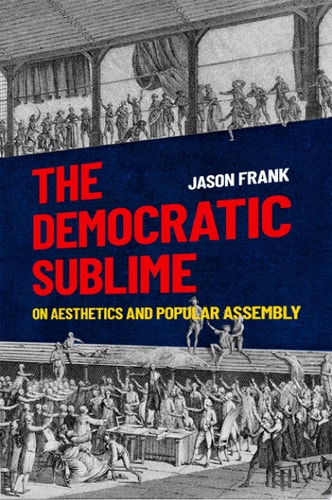
The Democratic Sublime: On Aesthetics and Popular Assembly
0
0
As an Amazon Associate and affiliate partner, Menrva Books earns from qualifying purchases. Learn more
Author Description
The transition from royal to popular sovereignty during the age of democratic revolutions--from 1776 to 1848--entailed not only the reorganization of institutions of governance and norms of political legitimacy, but also a dramatic transformation in the iconography and symbolism of political power. The personal and external rule of the king, whose body was the physical locus of political authority, was replaced with the impersonal and immanent self-rule of the people, whose power could not be incontestably embodied. This posed representational difficulties that went beyond questions of institutionalization and law, extending into the aesthetic realm of visualization, composition, and form. How to make the people's sovereign will tangible to popular judgment was, and is, a crucial problem of democratic political aesthetics. The Democratic Sublime offers an interdisciplinary exploration of how the revolutionary proliferation of popular assemblies--crowds, demonstrations, gatherings of the "people out of doors"--came to be central to the political aesthetics of democracy during the age of democratic revolutions. Jason Frank argues that popular assemblies allowed the people to manifest as a collective actor capable of enacting dramatic political reforms and change. Moreover, Frank asserts that popular assemblies became privileged sites of democratic representation as they claimed to support the voice of the people while also signaling the material plenitude beyond any single representational claim. Popular assemblies continue to retain this power, in part, because they embody that which escapes representational capture: they disrupt the representational space of appearance and draw their power from the ineffability and resistant materiality of the people's will. Engaging with a wide range of sources, from canonical political theorists (Rousseau, Burke, and Tocqueville) to the novels of Hugo, the visual culture of the barricades, and the memoirs of popular insurgents, The Democratic Sublime provides a new perspective on the aesthetic foundations of modern democracy.
Menrva's Summary
THE THESIS
How does the transition to popular sovereignty necessitate a new aesthetic framework for representing the collective will of the people? Jason A. Frank, a professor of government, examines the period between 1776 and 1848 to argue that the shift from monarchical rule to democratic self-governance created a representational crisis. He posits that popular assemblies—crowds and demonstrations—function as essential aesthetic sites where the people manifest their power, effectively resisting total capture by institutional or legal representation.
THE SCOPE MAP
What You Will Find
- Analysis of political theory from Rousseau, Burke, and Tocqueville.
- Examination of visual culture, including barricade iconography and revolutionary art.
- Interpretation of literary works, specifically the novels of Victor Hugo.
- Study of primary source memoirs from historical popular insurgents.
Scope Limits
- The text focuses primarily on the Western democratic revolutions between 1776 and 1848.
- It does not provide a comprehensive history of modern protest movements beyond the specified era.
THE AUTHORITY PERSPECTIVE
Scholars in political theory frequently cite this work for its sophisticated integration of aesthetics and democratic institutional history. Readers often note the academic density of the prose, which requires a strong background in political philosophy to fully synthesize the author's arguments.
Page Count:
273
Publication Date:
2021-01-01
Publisher:
Oxford University Press
ISBN-10:
0190658185
ISBN-13:
9780190658182
History
Special Topics
Political Philosophy
Democratic Theory
Democracy history
Aesthetics
Community Tags
Similar Books