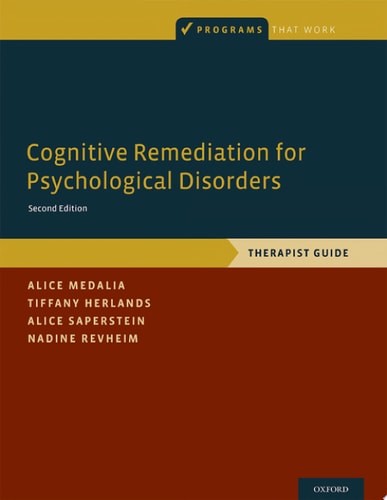
Cognitive Remediation for Psychological Disorders: Therapist Guide
0
0
As an Amazon Associate and affiliate partner, Menrva Books earns from qualifying purchases. Learn more
Author Description
Individuals with serious and persistent mental illnesses, including schizophrenia and affective disorders, often experience cognitive deficits that make it challenging to perform everyday tasks. For example, they may have difficulty paying attention, remembering and learning, thinking quickly, and solving problems, and this may interfere with functioning at work, school, and in social and living situations. Cognitive remediation is an evidence-based behavioral treatment for people who are experiencing cognitive impairments that interfere with role functioning. Cognitive Remediation for Psychological Disorders contains all the information therapists need to set up a cognitive remediation program that helps clients strengthen the cognitive skills necessary for everyday functioning. The program described is called Neuropsychological and Educational Approach to Remediation (NEAR), an evidence-based approach that utilizes carefully crafted instructional techniques which promote learning. The goals of NEAR are to provide a positive learning experience and to promote independent learning and optimal cognitive functioning in daily life. The second edition of this popular Therapist Guide provides step-by-step instructions on how to implement NEAR techniques with patients. Guidelines for setting up and running a successful cognitive remediation program are laid out in an easy-to-follow format. Therapists will learn how to choose appropriate cognitive exercises, recruit and work with clients, perform intakes, and create treatment plans. This Guide comes complete with all the tools necessary for facilitating treatment, including program evaluation forms and client handouts.
Menrva's Summary
THE THESIS
This guide investigates the implementation of the Neuropsychological and Educational Approach to Remediation (NEAR) to address cognitive deficits in individuals with serious mental illnesses. The authors, experts in neuropsychology and clinical practice, present a structured behavioral framework designed to improve functional outcomes for patients struggling with attention, memory, and problem-solving. By synthesizing clinical research with practical instructional techniques, the text provides a roadmap for therapists to facilitate cognitive recovery in diverse clinical settings.
THE SCOPE MAP
What You Will Find
- The NEAR (Neuropsychological and Educational Approach to Remediation) framework
- Step-by-step protocols for program setup and patient intake
- Clinical strategies for selecting cognitive exercises and creating treatment plans
- Practical tools including program evaluation forms and client handouts
Scope Limits
- The text focuses specifically on the NEAR model rather than comparing all available cognitive remediation modalities
- The guide assumes the reader has a baseline level of clinical training and does not serve as a general introduction to psychopathology
THE AUTHORITY PERSPECTIVE
Clinicians and mental health professionals frequently cite this guide as a foundational resource for establishing evidence-based cognitive remediation programs. Experts highlight the text for its practical utility and clear, step-by-step instructions that translate complex neuropsychological concepts into actionable clinical practice.
Page Count:
239
Publication Date:
2017-01-01
Publisher:
Oxford University Press
ISBN-10:
0190669950
ISBN-13:
9780190669959
Psychology
Mental Health
Cognitive Therapy
Community Tags
Similar Books