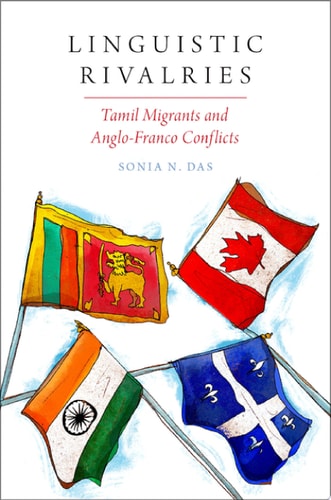
Linguistic Rivalries: Tamil Migrants and Anglo-Franco Conflicts
0
0
As an Amazon Associate and affiliate partner, Menrva Books earns from qualifying purchases. Learn more
Author Description
Linguistic Rivalries weaves together anthropological accounts of diaspora, nation, and empire to explore and analyze the multi-faceted processes of globalization characterizing the migration and social integration experiences of Tamil-speaking immigrants and refugees from India and Sri Lanka to Montréal, Québec in the late twentieth and early twenty-first centuries. In Montréal, a city with more trilingual speakers than in any other North American city, Tamil migrants draw on their multilingual repertoires to navigate longstanding linguistic rivalries between anglophone and francophone, and Indian and Sri Lankan nationalist leaders by arguing that Indians speak "Spoken Tamil" and Sri Lankans speak "Written Tamil" as their respective heritage languages. Drawing on ethnographic, archival, and linguistic methods to compare and contrast the communicative practices and language ideologies of Tamil heritage language learning in Hindu temples, Catholic churches, public schools, and community centers, this book demonstrates how processes of sociolinguistic differentiation are mediated by ethnonational, religious, class, racial, and caste hierarchies. Indian Tamils showcase their use of the "cosmopolitan" sounds and scripts of colloquial varieties of Tamil to enhance their geographic and social mobilities, whereas Sri Lankan Tamils, dispossessed of their homes by civil war, instead emphasize the "primordialist" sounds and scripts of a pure "literary" Tamil to rebuild their homeland and launch a "global" critique of racism and environmental destruction from the diaspora. This book uses the ethnographic and archival study of Tamil mobility and immobility to expose the mutual constitution of elite and non-elite global modernities, defined as language ideological projects in which migrants objectify dimensions of time and space through scalar metaphors.
Menrva's Summary
THE THESIS
This book investigates how Tamil-speaking migrants in Montréal navigate the city's complex linguistic landscape by leveraging specific language ideologies to negotiate their social and national identities. Sonia N. Das, an anthropologist specializing in language and diaspora, utilizes extensive ethnographic fieldwork and archival research to argue that language use among Tamil immigrants is not merely communicative but a strategic tool for navigating class, caste, and ethnonational hierarchies. By contrasting the linguistic practices of Indian and Sri Lankan Tamils, the author demonstrates how these groups construct distinct modernities through their divergent approaches to heritage language maintenance.
THE SCOPE MAP
What You Will Find
- Comparative analysis of Indian and Sri Lankan Tamil linguistic practices in Montréal.
- Ethnographic data from Hindu temples, Catholic churches, public schools, and community centers.
- Theoretical framework regarding language ideological projects and scalar metaphors.
Scope Limits
- The study is geographically confined to the Tamil diaspora within Montréal, Québec.
- The research focuses primarily on the late twentieth and early twenty-first centuries.
THE AUTHORITY PERSPECTIVE
Scholars in linguistic anthropology frequently cite this work for its nuanced application of sociolinguistic theory to the lived experiences of refugees and migrants. Experts highlight the text as a significant contribution to understanding how language ideologies mediate the integration of diaspora populations within multilingual urban environments.
Page Count:
269
Publication Date:
2016-01-01
Publisher:
Oxford University Press
ISBN-10:
0190675446
ISBN-13:
9780190675448
History
Anthropology
Tamil diaspora
English
English & College Success
Asian History
Linguistics
Introduction to Human Communication
Communications
Migration Studies
Quebec Studies
Canadian History
Community Tags
Similar Books