Navigation by Judgment
0
0
As an Amazon Associate and affiliate partner, Menrva Books earns from qualifying purchases. Learn more
Author Description
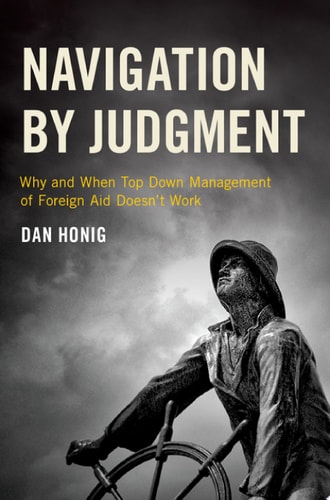
Foreign Aid Organizations Collectively Spend Hundreds Of Billions Of Dollars Annually, With Mixed Results. Part Of The Problem In These Endeavors Lies In Their Execution. In Navigation By Judgment, Dan Honig Argues That High-quality Implementation Of Foreign Aid Programs Often Requires Contextual Information That Cannot Be Seen By Those In Distant Headquarters. Drawing On A Novel Database Of Over 14,000 Discrete Development Projects Across Nine Aid Agencies And Eight Paired Case Studies Of Development Projects, Honig Shows That Aid Agencies Will Often Benefit From Giving Field Agents The Authority To Use Their Own Judgments To Guide Aid Delivery. This Navigation By Judgment Is Particularly Valuable When Environments Are Unpredictable And When Accomplishing An Aid Program's Goals Is Hard To Accurately Measure. Highlighting A Crucial Obstacle For Effective Global Aid, Navigation By Judgment Shows That The Management Of Aid Projects Matters For Aid Effectiveness.
Menrva's Summary
THE THESIS
This book investigates why foreign aid programs frequently fail and argues that the solution lies in shifting decision-making authority from distant headquarters to field agents. Dan Honig, an expert in international development and public policy, utilizes a rigorous analytical framework to examine how organizational structure impacts project outcomes. He posits that when environments are volatile and goals are difficult to quantify, empowering local staff to exercise judgment is superior to rigid, top-down management.
THE SCOPE MAP
What You Will Find
- A comprehensive database of over 14,000 discrete development projects.
- Comparative analysis of nine major international aid agencies.
- Eight detailed paired case studies of specific development initiatives.
- A theoretical framework for measuring organizational autonomy versus control.
Scope Limits
- The analysis focuses primarily on institutional management rather than the geopolitical ethics of aid.
- The study does not provide a manual for individual project implementation but rather a systemic critique of organizational design.
THE AUTHORITY PERSPECTIVE
Experts in international development recognize this work as a significant contribution to the study of organizational behavior within aid agencies. Readers frequently note the academic density of the prose, which is balanced by the extensive empirical data provided to support the author's conclusions.
Page Count:
240
Publication Date:
2018-01-01
Publisher:
Oxford University Press
ISBN-10:
0190672463
ISBN-13:
9780190672461
International relations
Foreign Aid
Public Administration
Community Tags
Similar Books