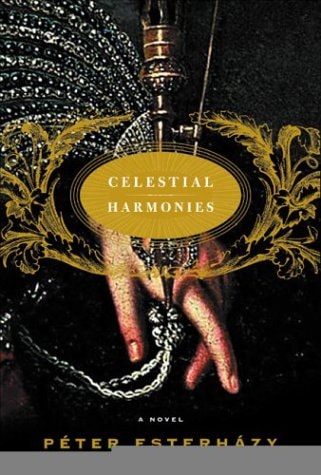
Harmonia Caelestis
0
0
As an Amazon Associate and affiliate partner, Menrva Books earns from qualifying purchases. Learn more
Author Description
Harmonia Caelestis is the product of a decade of a monumental, part-autobiographical family history. If Helping Verbs of the Heart was an homage to his mother, then this is a memorial to his father. It is actually two works in one. Book 1, "Numbered Sentences from the Life of the Esterházy Family", comprises 371 paragraphs, some elusively succinct, others pages long, that amount to a gloriously kaleidoscopic romp through the centuries that lie behind this European dynasty. Not that the name Esterházy is ever the main protagonist of each episode is invariably identified as "my father", whether he is an anti-Habsburg Kuruc insurrectionist or a Habsburg-loyal Labanc, a hammer of the Ottomans, a dying old man, a prisoner of war, a lord charming enough to enchant Goethe himself, or a childless man, to mention but a few of "my fathers", all evoked through the language and literature proper to each persona. This strategy of anonymity allows Esterházy to extend his typically vast net of quotations to sources that originally have no family connotations whatsoever, thereby lending broader significance to the particulars of this one family, however grand, and, vice versa, appropriating the general (European) experience to the family's specific circumstances. The baroquely exuberant proliferation of anecdotal gleanings and fragments of real and fictional history, drawing on a gamut of written genres, from maxims to parables, from confessional autobiography to the account books and chronicles, is ultimately threaded together by an unobtrusive, profoundly witty and wise philosophical vein.Book 2, subtitled "Confessions of an Esterházy family", is ostensibly a more conventional family novel. Its very subtitle alludes to an earlier Hungarian masterpiece of the genre, Confessions of a Bourgeois, 1934-35 by Sándor Márai. It consists of a series of snapshots of key events in the lives of the author's great-grandfather, grandfather, father and the young Esterházy himself. These are bui
Menrva's Summary
THE PULSE
The central conflict involves the author’s attempt to reconcile the mythic, multi-generational legacy of the Esterházy dynasty with the intimate, often contradictory reality of his own father. The protagonist navigates a vast, non-linear narrative landscape where the identity of 'my father' shifts across centuries, roles, and political allegiances. Opposing this search for truth are the weight of historical myth, the instability of memory, and the inherent difficulty of capturing a life through the fragmented lens of literature. The narrative framework alternates between a kaleidoscopic collection of numbered, aphoristic observations and a more structured, conventional family chronicle.
INSIDE THE PAGES
- Non-linear, episodic structure composed of 371 distinct, numbered paragraphs.
- Extensive use of intertextuality and literary quotation to broaden the scope of family history.
- Stylistic mimicry that adapts the prose to match the historical era of each persona.
- Blending of historical fact with anecdotal, fictionalized family lore.
- Philosophical inquiry into the nature of identity and the passage of time.
- Dual-book structure contrasting aphoristic fragments with a more traditional novelistic approach.
- Meta-fictional commentary on the act of writing and the construction of family memory.
- Integration of diverse genres including maxims, parables, and personal confession.
THE COLLECTIVE ECHO
This work is widely regarded as a significant achievement in contemporary European literature, noted for its linguistic exuberance and structural ambition. Critics often highlight the author's ability to balance the specific history of the Esterházy family with broader, universal themes of power, loss, and identity. The text is frequently praised for its wit and the profound philosophical depth that anchors its more playful, baroque stylistic choices. Readers and scholars alike recognize the book as a complex, demanding, yet rewarding exploration of the relationship between personal history and the grander narratives of the past. The synthesis of disparate literary forms creates a unique reading experience that challenges conventional expectations of the family saga genre.
Page Count:
846
Publication Date:
2004-01-01
Publisher:
HarperCollins Publishers Ltd
ISBN-10:
0002005352
ISBN-13:
9780002005357
Literary Fiction
Historical Fiction
Subjects
European
Autobiographical fiction
Hungarian
Family Saga
Community Tags
Similar Books