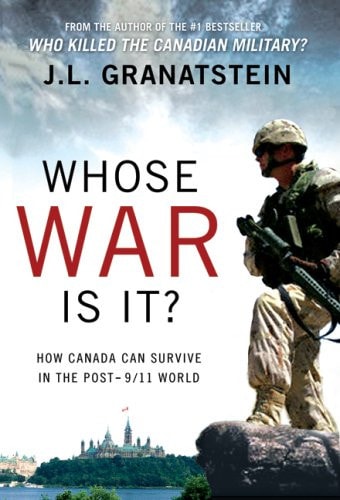
Whose War Is It?: How Canada Can Survive the Post-9/11 World
0
0
As an Amazon Associate and affiliate partner, Menrva Books earns from qualifying purchases. Learn more
Author Description
What if a major earthquake devastated the west coast of North America, killing thousands of people, flattening entire cities and fracturing the economy? How would the Canadian government address the crisis when many of our already weakened forces are deployed in Kandahar or in supporting roles? Or suppose terrorists attacked the Toronto subway system during a convention of Canadian and American emergency-room physicians? Would our military have the manpower, equipment and technical resources to protect our citizens and visitors?Granatstein says never mind hypothetical―and completely probable―threats; our military is incapable of dealing with current and ongoing crises that require well-trained, well-equipped and properly deployed troops, supported by a confident military policy. He argues that Canadians’ once-vaunted role of peacekeeping is no longer relevant in a post-9/11 world, since recent missions, from Somalia to Kosovo to Afghanistan, are akin to war. Granatstein also takes Canadian attitudes to task, criticizing our increasing reluctance to support a military presence in countries such as Afghanistan.Whose War Is It? asks the questions Canadians need answered right now:• How can we negotiate with US policymakers when anti-American sentiment is affecting our military and foreign policies?• Do multiculturalism and our immigration policy make us vulnerable to terrorist attacks?• How can we protect our northern sovereignty most effectively?• What should we do about a “pacifist” Quebec?• Just what are Canada’s national interests, and how can we advance them?In the same tradition as his #1 bestseller Who Killed the Canadian Military?, Whose War Is It? is a hard-hitting, timely clarion call to arms.
Menrva's Summary
THE THESIS
How can Canada effectively redefine its national security and military capabilities to survive in a volatile post-9/11 global landscape? J. L. Granatstein, a prominent Canadian military historian, utilizes his extensive academic background to critique the decline of the Canadian Armed Forces. He argues that the traditional reliance on peacekeeping is obsolete and that Canada must pivot toward a more robust, well-equipped, and strategically aligned military policy to address modern threats.
THE SCOPE MAP
What You Will Find
- Analysis of the limitations of the Canadian military regarding manpower, equipment, and emergency response capabilities.
- Examination of the shifting nature of international missions from peacekeeping to active combat operations.
- Critical assessment of Canadian foreign policy, including the impact of anti-American sentiment on national interests.
- Discussion on the intersection of domestic policies, such as multiculturalism and immigration, with national security vulnerabilities.
THE AUTHORITY PERSPECTIVE
The text presents a provocative, polemical argument that challenges established Canadian political orthodoxy regarding defense and sovereignty. Its focus on the necessity of military modernization and a re-evaluation of national interests provides a clear, albeit controversial, framework for readers interested in Canadian geopolitical strategy.
Page Count:
246
Publication Date:
2007-01-23
Publisher:
Phyllis Bruce Books
ISBN-10:
0002008459
ISBN-13:
9780002008457
History
Politics
Military History
Military
Canada
National security
International relations
Canadian History
Community Tags
Similar Books