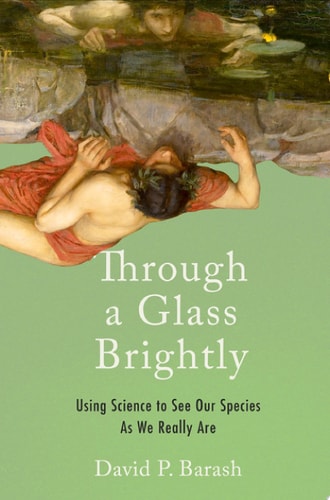
Through a Glass Brightly: Using Science to See Our Species as We Really Are
0
0
As an Amazon Associate and affiliate partner, Menrva Books earns from qualifying purchases. Learn more
Author Description
Human beings have long seen themselves as the center of the universe, the apple of God's eye, specially-created creatures who are somehow above and beyond the natural world. This viewpoint--a persistent paradigm of our own unique self-importance--is as dangerous as it is false.In Through a Glass Brightly, noted scientist David P. Barash explores the process by which science has, throughout time, cut humanity "down to size," and how humanity has responded. A good paradigm is a tough thing to lose, especially when its replacement leaves us feeling more vulnerable and less special. And yet, as science has progressed, we find ourselves--like it or not--bereft of many of our most cherished beliefs, confronting an array of paradigms lost.Barash models his argument around a set of "old" and "new" paradigms that define humanity's place in the universe. This new set of paradigms range from provocative revelations as to whether human beings are well designed, whether the universe has somehow been established with our species in mind (the so-called anthropic principle), whether life itself is inherently fragile, and whether Homo sapiens might someday be genetically combined with other species (and what that would mean for our self-image). Rather than seeing ourselves through a glass darkly, science enables us to perceive our strengths and weaknesses brightly and accurately at last, so that paradigms lost becomes wisdom gained. The result is a bracing, remarkably hopeful view of who we really are.
Menrva's Summary
THE THESIS
This book investigates the persistent human tendency to view our species as central to the universe and examines how scientific discovery systematically challenges these anthropocentric beliefs. David P. Barash, a professor of psychology and biology, utilizes historical scientific milestones and contemporary evolutionary theory to argue that accepting our biological reality is a necessary step toward genuine wisdom. He posits that while losing our sense of unique importance is initially disorienting, it ultimately provides a more accurate and constructive understanding of our place in the natural world.
THE SCOPE MAP
What You Will Find
- Analysis of the shift from teleological worldviews to evolutionary perspectives
- Examination of the anthropic principle and its implications for human significance
- Discussion on the biological design of Homo sapiens and the fragility of life
- Exploration of future possibilities regarding genetic integration with other species
Scope Limits
- The text does not provide a comprehensive history of all scientific disciplines
- It does not offer a theological or metaphysical defense of human uniqueness
THE AUTHORITY PERSPECTIVE
Readers frequently note the accessible yet rigorous nature of Barash's prose, which balances complex biological concepts with philosophical inquiry. Experts highlight this as a clear-eyed synthesis for those interested in the intersection of evolutionary biology and human self-perception.
Page Count:
216
Publication Date:
2018-08-01
Publisher:
Oxford University Press
ISBN-10:
0190673710
ISBN-13:
9780190673710
Science
Evolution
Human beings
Human ecology
Human Nature
Evolutionary Biology
Philosophy of
Anthropology
Philosophical anthropology
Community Tags
Similar Books